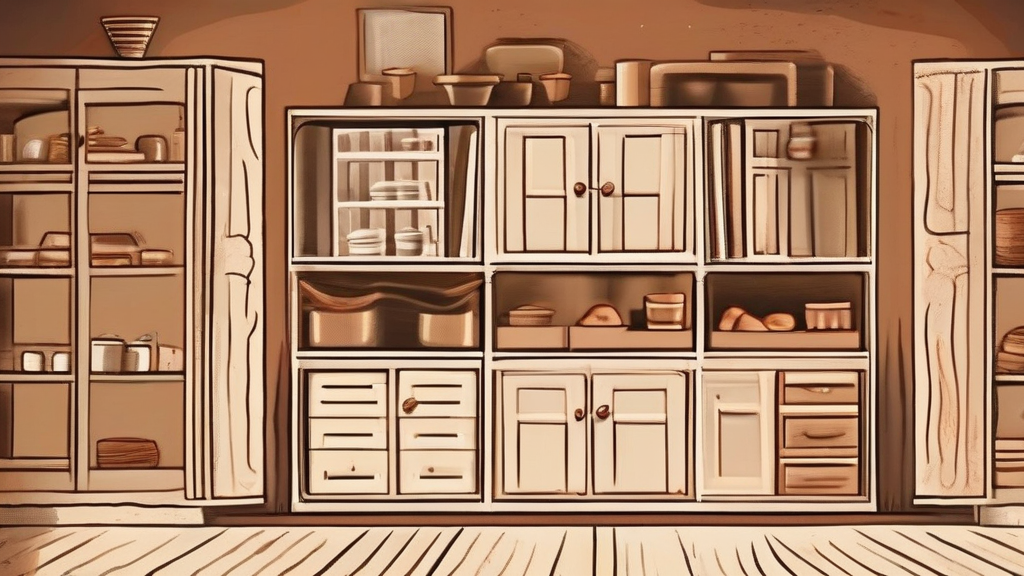
What does cupboard mean?
A cupboard is an enclosed piece of storage furniture, usually fitted with doors and interior shelves, used to keep food, crockery, linens, clothing, and other household goods tidy and out of sight. Cupboards range from freestanding pieces to units built into kitchens, bedrooms, and hallways, and they are among the most familiar fixtures of domestic life. In everyday speech the word appears constantly in phrases like 'kitchen cupboard' or 'the cupboard is bare', the latter signalling a lack of food or supplies. It also lends its name to the idiom 'a skeleton in the cupboard' — a shameful family secret kept hidden — which is the British counterpart of the American 'skeleton in the closet'. Though common in both countries, the term is markedly more prevalent in British English, where it can denote anything from a small built-in alcove under the stairs to a full wardrobe, whereas Americans tend to say 'cabinet' or 'closet' instead. Its long history in English gives it a warm, homey connotation.
nounA piece of furniture with shelves or compartments, typically fitted with doors, used for storing food, dishes, clothes, or other household items.
- A storage unit with doors and shelves for household items such as food, dishes, or clothing.
- (British) A small room or recess used as a storage space, especially a built-in one.
"She opened the kitchen cupboard and reached for a tin of tomatoes."
"The plates were stacked neatly on the top shelf of the cupboard."
"In many older English houses, the broom was kept in a narrow cupboard under the stairs."
The plural follows regular English patterns; it commonly describes multiple storage units, as when describing a fully stocked or newly fitted kitchen.
"All the cupboards in the old farmhouse were hand-painted."
A 'skeleton in the cupboard' — the British cousin of America's 'skeleton in the closet' — has been hiding family secrets since the early 1800s.
Reviewed by Deb Chak, Editor. AI-assisted content curated by RJS Tech Solutions LLP.
Etymology of cupboard
Cupboard originated in late medieval England as a compound of 'cup' and 'board', literally meaning a board or table on which cups and dishes were displayed — an open sideboard rather than an enclosed case. Over time the word shifted meaning: by the sixteenth century it had come to describe a closed piece of furniture with doors and shelves for storing such items, and eventually any similar storage space. The word is entirely native English in formation, combining two Old English-rooted elements ('cup', ultimately from Latin 'cuppa' via Old English, and 'board', from Old English 'bord'). Its cognate compounds include words like 'bookcase' and 'sideboard', which followed a similar path from surface to enclosure.
How cupboard is actually used
Far more common in British than American usage; Americans more often say 'cabinet' or 'closet'. In Britain 'cupboard' covers everything from kitchen units to built-in wardrobes. The phrase 'cupboard love' refers to affection shown for what someone can gain from you rather than genuine feeling.
Easily confused with cupboard
A closet is a small enclosed space built into a room's wall (especially in North America), while a cupboard is a piece of furniture with doors and shelves that stands alone or is built in.