What does cuprite mean?
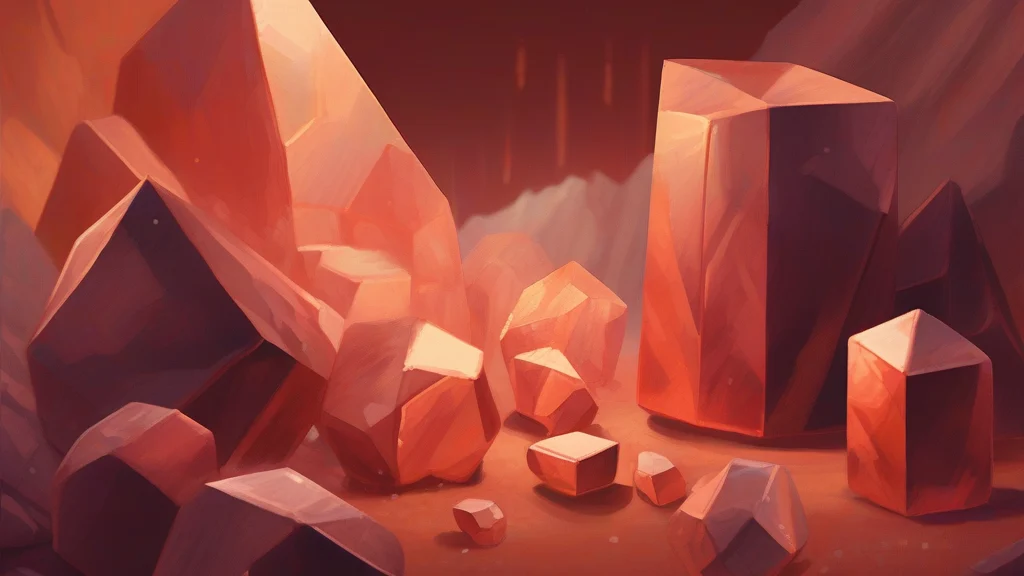
Cuprite is a copper oxide mineral with the chemical formula Cu₂O, named for its copper content. It typically crystallises in cubic or octahedral forms and ranges in colour from deep red to reddish brown, sometimes appearing nearly black in opaque specimens. Because it contains a high proportion of copper by weight, cuprite has long served as a valuable ore of the metal, though it is far less abundant than sulphide ores such as chalcopyrite. Fine, translucent crystals — occasionally cut as collector's gems — command particular interest among mineral enthusiasts, with notable occurrences recorded in localities such as Cornwall, Namibia, Chile, and Arizona. The word belongs chiefly to the vocabulary of mineralogy, mining, and geology rather than general usage. For readers interested in earth sciences, cuprite offers a vivid example of how chemistry, crystal structure, and economic value intersect in a single naturally occurring substance.
nounA red copper oxide mineral, cuprous oxide (Cu₂O), that occurs as cubic or octahedral crystals and is an important ore of copper.
- The mineral cuprous oxide (Cu₂O), typically occurring as red to reddish-brown octahedral or cubic crystals, valued as a copper ore and prized by collectors.
"The museum's mineral gallery displays a brilliant specimen of cuprite from the Bisbee mines in Arizona."
"Veins of native copper were found intergrown with cuprite near the surface of the deposit."
"Collectors pay high prices for translucent, gem-quality cuprite crystals, which are exceptionally rare."
The plural is rare in practice; mineral names are usually treated as mass nouns when referring to the substance generally, with the plural reserved for distinct specimens or varieties.
"The drawer contained several fine cuprites from the Cornish mines."
Its deep ruby-red crystals are so striking that miners once called it 'ruby copper' — but cut a facet and you may be surprised: some gem-quality cuprite appears almost black until light passes through.
Reviewed by Deb Chak, Editor. AI-assisted content curated by RJS Tech Solutions LLP.
Etymology of cuprite
Cuprite derives from the Latin "cuprum", meaning copper, combined with the mineral suffix "-ite"; the name was coined in the mid-nineteenth century as mineralogists formalised nomenclature for distinct species. "Cuprum" itself comes from "aes Cyprium", literally "metal of Cyprus", reflecting that island's ancient importance as a source of copper. Related English words sharing this Latin root include "cupric", "cuprous", "cupel", and "cupriferous".
How cuprite is actually used
"Cuprite" is a technical term used mainly in mineralogy, geology, and mining contexts; it is rarely encountered in everyday speech. The adjectival forms "cuprous" (copper(I)) and "cupric" (copper(II)) describe copper's oxidation states rather than referring to the mineral itself.
Easily confused with cuprite
Chalcocite is a copper sulfide (Cu₂S) with a dark lead-grey colour, whereas cuprite is a red copper oxide.
'Cupric' is an adjective describing divalent copper in chemical compounds, while 'cuprite' is the noun naming the mineral itself.