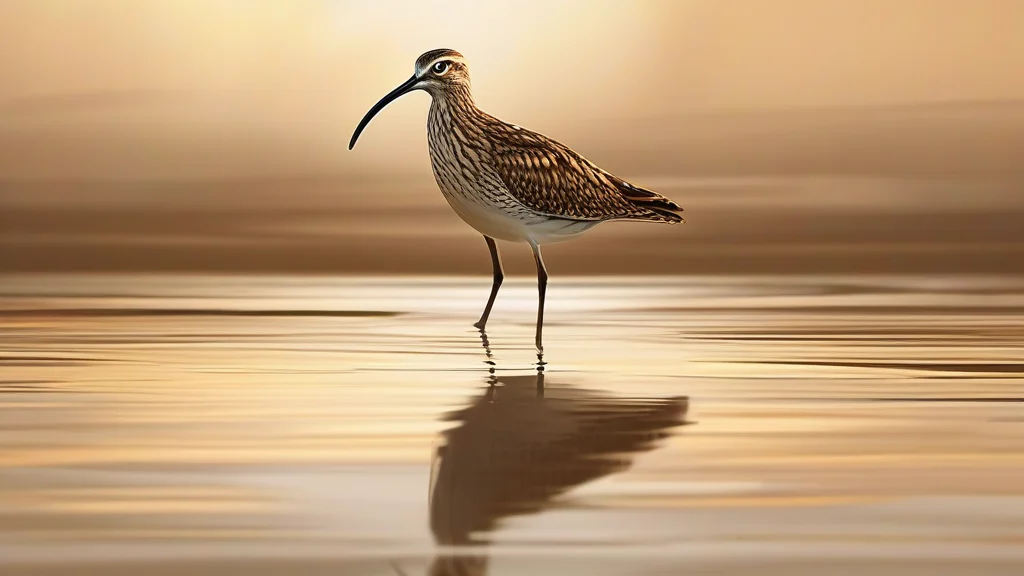
What does curlew mean?
A curlew is a large wading bird belonging to the genus Numenius within the sandpiper family Scolopacidae. Instantly recognizable by its long legs, mottled brown plumage, and remarkably long, downward-curved bill, the curlew uses this specialized beak to probe soft mud and soil for worms, crustaceans, and other invertebrates. Several species exist worldwide, including the Eurasian curlew of Europe and Asia and the long-billed curlew of North America, while closely related forms such as the whimbrel are distinguished by size and markings. The word carries strong cultural weight, especially in Britain and Ireland, where the curlew's eerie, bubbling cry has become an emblem of moorlands, marshes, and coastal wildness, appearing frequently in poetry and prose. Because many curlew populations have declined markedly in recent decades due to habitat loss, the bird has also become a prominent symbol in conservation campaigns, making it a word that connects natural history, landscape writing, and environmental concern.
nounA large shorebird of the genus Numenius, in the sandpiper family Scolopacidae, having long legs, brown streaked plumage, and a distinctive long, down-curved bill.
- Any of several large wading birds of the genus Numenius, known for their long, downward-curving bills and mournful, bubbling calls.
"The haunting cry of the curlew echoed across the misty marshland at dawn."
"A flock of curlews gathered along the tidal flats at low tide."
"Conservationists have worked for decades to protect the curlew's breeding grounds on the upland moors."
Standard pluralization; simply add -s.
"Curlews arrive on the coast in large numbers each autumn."
The curlew's bill can curve downward by up to six inches, letting it probe deep into mud for worms its eyes will never see.
Reviewed by Deb Chak, Editor. AI-assisted content curated by RJS Tech Solutions LLP.
Etymology of curlew
The word 'curlew' entered Middle English in the Middle Ages, borrowed from Old French 'corliu' (also appearing as 'courlieu'), which itself is of uncertain ultimate origin. One traditional explanation links it imitatively to the bird's plaintive call, though this remains speculative rather than established. The name was applied to the familiar Eurasian species and later extended to similar birds elsewhere, giving rise to compound names such as 'curlew sandpiper' and 'stone-curlew', the latter now placed in an entirely different family despite the shared name.
How curlew is actually used
In British usage, 'the curlew' typically refers to the Eurasian curlew, a well-known and culturally resonant bird whose call is often evoked in poetry and literature as a sound of wild places. In North America, 'curlew' most often means the long-billed curlew.
Easily confused with curlew
The whimbrel is a smaller relative of the curlew with a shorter bill and a striped crown.