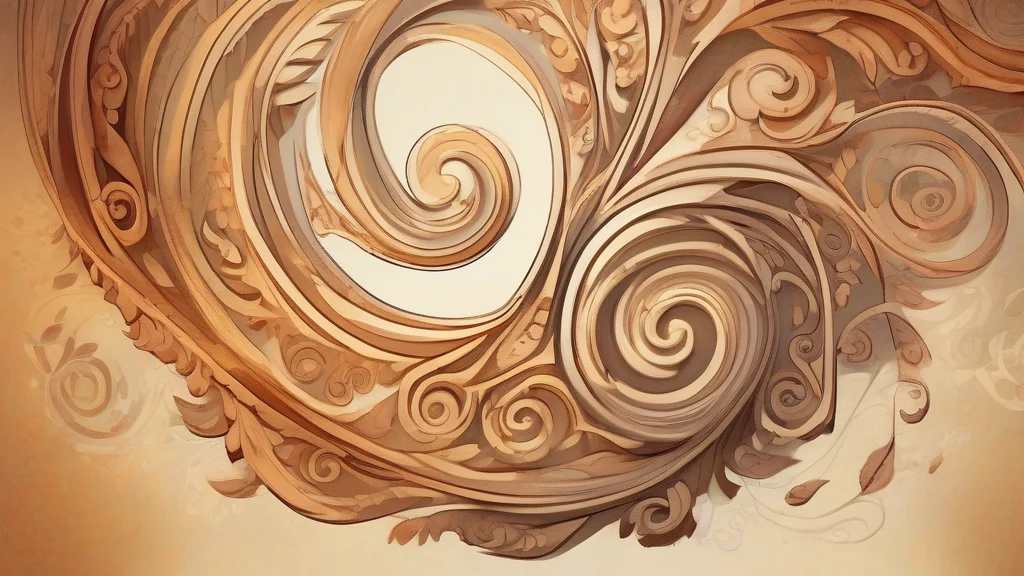
What does curlicue mean?
A curlicue is a small, ornamental curl — a spiral or looping flourish found in decorative writing, typography, wrought iron, architectural ornament, and illustration. The word suggests something fanciful and elaborate rather than functional: the swirling scrolls on a Victorian gate, the exaggerated tail on a signature, or the delicate whorls of a woodcarver's detail. By extension, it can describe anything that winds in graceful spirals, such as a thin curlicue of smoke rising from a chimney or a loose strand of hair. The term carries a light, often affectionately ornate connotation, and writers reach for it when they want to emphasize decoration that is playful rather than grand. It functions almost exclusively as a noun, with 'curlicues' as its plural. Its charm lies partly in its sound — the word itself seems to curl off the tongue, echoing the shapes it describes.
A decorative curl or spiral flourish, especially one used in ornamental design, calligraphy, or ironwork.
"The invitation was addressed in flowing script adorned with tiny golden curlicues."
Often used in the plural when describing repeated ornamental patterns.
A twisting, curling shape or wisp, such as rising smoke or a lock of curled hair.
"A lazy curlicue of steam drifted up from her coffee cup."
The regular plural is standard and is the most common way the word appears, since ornamental designs usually feature multiple curls.
"The balustrade was carved with dozens of symmetrical curlicues."
The word itself twists: 'curlicue' fuses the English 'curl' with the French 'cue' (a tail), so its very name is a little linguistic knot.
Reviewed by Deb Chak, Editor. AI-assisted content curated by RJS Tech Solutions LLP.
Etymology of curlicue
Curlicue is thought to be a blend of the English word 'curl', from Old Norse, and the element 'cue', meaning a tail or queue, which entered English from French ('queue', from Latin 'cauda'). The compound arose in English in the mid-nineteenth century, when it began appearing in descriptions of decorative flourishes. It shares its lineage with words built on notions of curling, coiling, and tails rather than with any single classical root.
How curlicue is actually used
Curlicue has a light, decorative, often whimsical connotation; it is more specific and playful than plain 'curl' and appears frequently in descriptions of ornate typography, wrought iron, and calligraphy. Used figuratively for wisps of smoke or hair. No strongly regional variation between British and American English.
Easily confused with curlicue
A curl is any coiled shape or lock of hair, whereas a curlicue specifically denotes an ornamental spiral or flourish used decoratively.