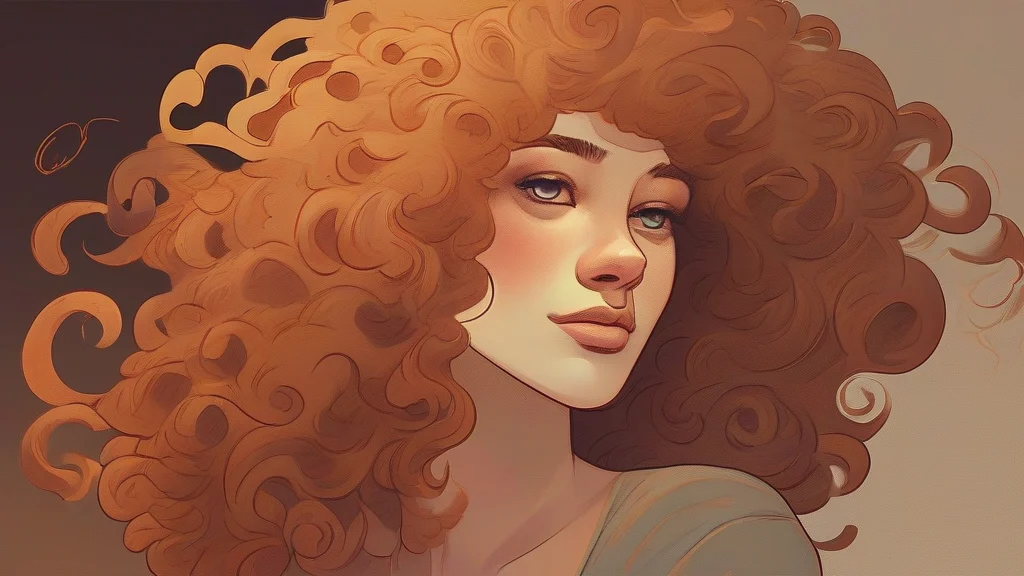
What does curliness mean?
Curliness is a noun denoting the state, condition, or degree of being curly — that is, forming a series of curls or coils rather than lying flat or straight. It is formed from the adjective 'curly' by adding the suffix '-ness', which converts qualities into abstract nouns, in the same way 'happy' becomes 'happiness'. The word appears most frequently in everyday conversation about human hair texture, where curliness may be discussed as a genetic trait or a matter of personal styling. Beyond hair, it finds practical application in technical fields: textile specialists assess the curliness of wool fibres because it influences softness and elasticity, while botanists may note the curliness of tendrils or leaves. The word carries no emotional connotation of its own; it simply names a physical property. Related forms include the adjective 'curly' and its comparative and superlative degrees.
nounThe state or quality of being curly; the degree to which hair, fur, or other material is curled or forms curls.
- The state or condition of having curls or being curly, especially of hair.
- The degree to which something (such as wool, fibre, or a plant tendril) is curled or coiled.
"Her natural curliness became a point of pride once she stopped straightening her hair."
"Genetics largely determine the curliness of a person's hair."
"Breeders select sheep for the curliness of their fleece, which affects the quality of the wool."
Rarely pluralised, as it is an abstract quality; the singular form is almost always used even when referring to multiple subjects.
"The chart compared the curliness of different hair types across populations."
That '-ness' suffix does heavy lifting here: it turns a simple visual trait into a measurable property — which is exactly how scientists quantify everything from sheep's wool to human hair types.
Reviewed by Deb Chak, Editor. AI-assisted content curated by RJS Tech Solutions LLP.
Etymology of curliness
Curliness derives from 'curly', an English adjective formed from the noun 'curl' plus the adjectival suffix '-y', with the further addition of the abstract-noun suffix '-ness'. The noun 'curl' entered Middle English in the fifteenth century, probably from Dutch or Low German cognates such as 'krul' (curl), though its deeper origins are uncertain. Words such as 'crisp' and 'crescent' trace back to Latin 'crispare' ('to curl') and 'crescere' respectively, illustrating the broader Indo-European family of words associated with curvature and undulation.
Related word forms
How curliness is actually used
A neutral, descriptive term with no strong connotation. Most often encountered in discussions of hair texture, but also used in textile science and botany. Somewhat formal compared with casual phrases like 'having curly hair'.
Easily confused with curliness
Curling refers to the act or process of forming curls (or the ice sport), while curliness is the inherent quality of already being curly.