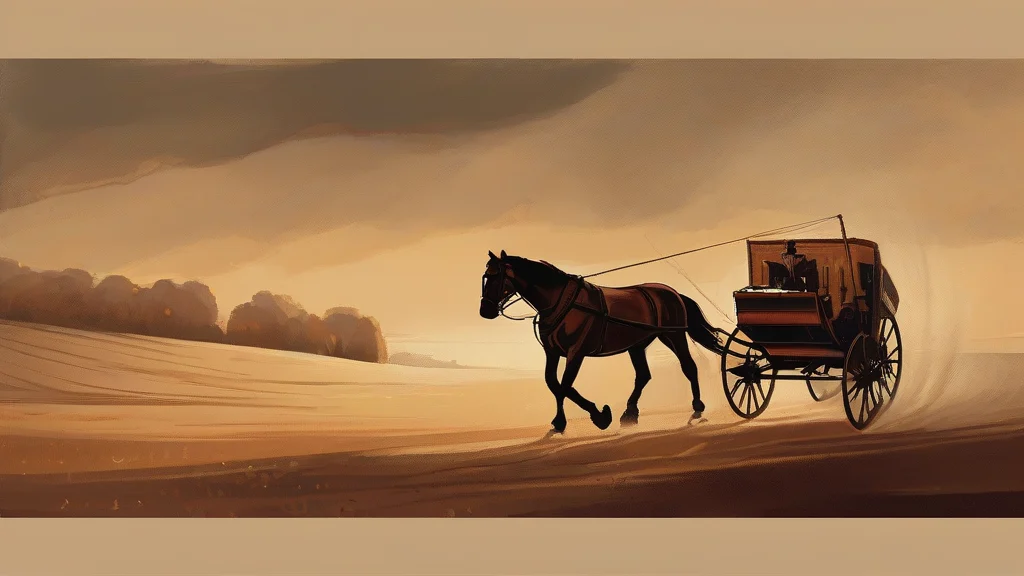
What does curricle mean?
A curricle is a light, open, two-wheeled horse-drawn carriage drawn by a pair of horses, which enjoyed great fashionability in Britain during the late eighteenth and early nineteenth centuries. Unlike heavier carriages that required a hired coachman, a curricle was designed to be driven by its owner, making it the favored conveyance of fashionable young gentlemen — much like a sports car today. It was costly to run, since it demanded a matched pair of horses, so owning one signaled wealth and style. The word appears frequently in the literature of the period, most famously in Jane Austen's novels, where characters' choice of carriage reflects their character and standing. Today, curricle survives mainly as a historical and literary term, encountered in accounts of the Regency era, period drama, and antiquarian writing about carriages and coaching.
nounA curricle is a light, open two-wheeled horse-drawn carriage, typically drawn by a pair of horses, popular in the late 18th and early 19th centuries. It was usually driven by the owner himself rather than by a hired coachman.
- A light, open, two-wheeled carriage drawn by two horses abreast, driven by its owner; fashionable in Britain from the late 18th to early 19th century.
"He drove up to the door in his smart new curricle, his pair of greys tossing their heads."
"The young officer arrived at the assembly rooms in his curricle, turning every head as he reined in the pair."
"She watched from the window as his curricle rattled away down the gravel drive toward London."
The standard plural adds -es; used when referring to multiple carriages, as in inventories or historical accounts.
"The mews held several curricles alongside the family's heavier travelling coach."
In Jane Austen's Persuasion, the vain Mr. Elliot's smart curricle is a badge of style — because in Regency England, driving your own curricles-and-pair was the equivalent of pulling up in a convertible sports car.
Reviewed by Deb Chak, Editor. AI-assisted content curated by RJS Tech Solutions LLP.
Etymology of curricle
Curricle entered English in the early seventeenth century, borrowed from the French 'curricle' (earlier 'coureculle'), which derived ultimately from the Latin 'curriculum', meaning 'a running, race, or course', itself from 'currere', 'to run'. The same Latin root gives English words such as 'current', 'courier', and 'curriculum'. The name suits the vehicle well, as the curricle was built for speed and lightness rather than capacity.
How curricle is actually used
Curricle is now almost entirely historical and literary in register; it appears chiefly in discussions of the Georgian and Regency eras and in period fiction such as Jane Austen's novels. The word connotes gentility, fashion, and youthful display — a curricle was expensive to keep and was driven by its owner, often a young man of means.
Easily confused with curricle
Despite the similar spelling, 'curricle' is a two-wheeled horse-drawn carriage, whereas 'circle' is a perfectly round plane figure or an associated group.
A gig is a lighter, one-horse two-wheeled carriage, while a curricle is drawn by a pair of horses in tandem or side by side.