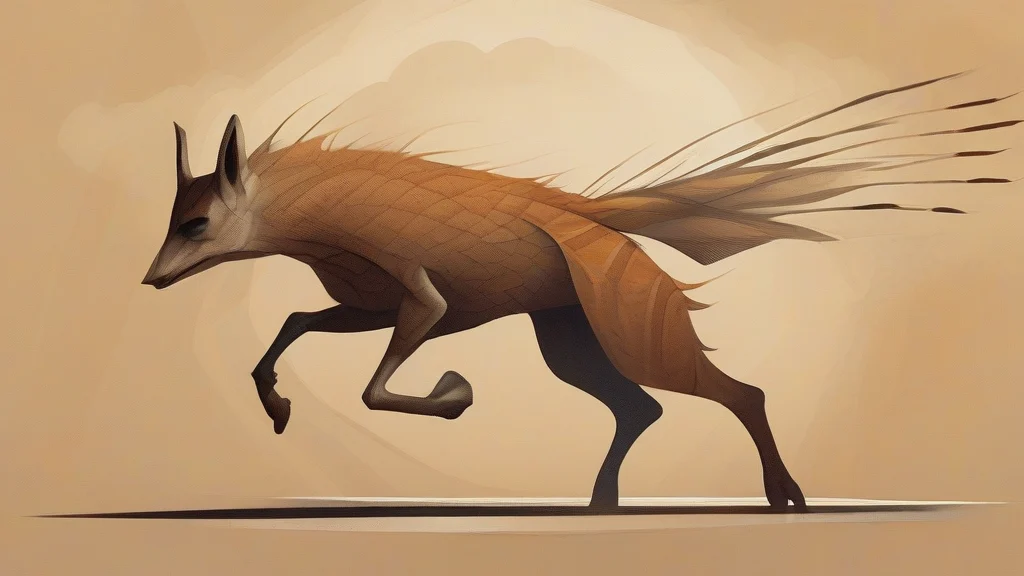
What does cursorial mean?
Cursorial is an adjective meaning adapted for or specialized in running. It is primarily a scientific term, used most often in zoology, paleontology, and evolutionary biology to describe animals whose skeletons, limbs, and body proportions have been shaped by natural selection for efficient or rapid movement on land. Classic cursorial animals include the cheetah, pronghorn, horse, and ostrich — creatures marked by long limbs, reduced digits, and streamlined bodies. The word also appears in theoretical contexts, as in the 'cursorial hypothesis' of bird flight, which proposes that flying birds descended from ancestors that ran along the ground rather than gliding from trees. Because it belongs to formal academic register, cursorial is unlikely to surface in casual speech, but it is precise and widely understood within biological literature. Its counterpart, 'fossorial,' describes animals adapted for digging instead of running.
adjectiveAdapted for or specialized in running; used especially of animals whose limbs and body structure are modified for rapid terrestrial locomotion.
- Adapted for running: describing animals whose anatomy is specialized for fast or sustained terrestrial locomotion.
- Relating to or characterized by running.
"The pronghorn is one of the most cursorial mammals in North America, capable of sustained high-speed running."
"Cheetahs are supremely cursorial predators, with lightweight frames and elongated limbs built for speed."
"The fossil evidence suggests this species was more cursorial than its close relatives."
When scientists debate whether birds evolved flight from the ground up, they call it the 'cursorial hypothesis' — literally, the theory that flight began with a running start.
Reviewed by Deb Chak, Editor. AI-assisted content curated by RJS Tech Solutions LLP.
Etymology of cursorial
Cursorial derives from the Latin verb 'currere,' meaning 'to run,' via its participle stem 'curs-,' which also gives English words such as 'cursor,' 'current,' 'cursive,' and 'course.' The adjective entered English in the nineteenth century through zoological usage, as naturalists needed a systematic term for running-specialized animals alongside categories like 'fossorial' and 'arboreal.' Its Latin root connects it to a broad family of English words all concerned with movement or progression.
Related word forms
How cursorial is actually used
Cursorial is a technical term used chiefly in zoology, paleontology, and evolutionary biology. It carries a neutral, scientific connotation and rarely appears in everyday conversation. The contrastive term 'fossorial' (adapted for digging) is often paired with it in discussions of limb morphology.
Easily confused with cursorial
Curatorial relates to the care and management of museum or gallery collections, whereas cursorial relates to running or adapted for running.