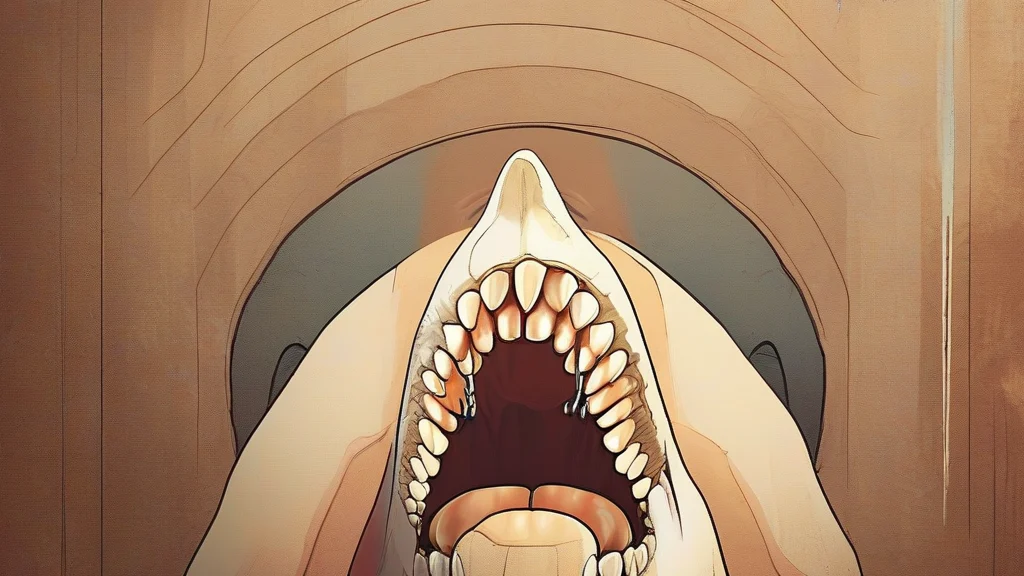
What does cuspid mean?
A cuspid is one of the four pointed, cone-shaped teeth found in humans, positioned between the incisors at the front of the mouth and the premolars further back — two in the upper jaw and two in the lower. Commonly known as the canine teeth, these are the longest and most prominent teeth in the human mouth, playing an essential role in gripping and tearing food. The word derives from the Latin 'cuspis', meaning a point or spear-tip, which also gives us related terms like 'bicuspid' for the two-cusped premolar teeth. Beyond dentistry, 'cuspid' occasionally refers to any pointed projection, such as the leaflets of certain heart valves. While laypeople usually speak simply of their 'canines' or 'eye teeth', the term cuspid remains standard vocabulary among dentists, orthodontists, and anatomists, appearing frequently in clinical descriptions, radiology reports, and discussions of dental development and alignment.
A pointed, cone-shaped tooth; especially one of the four canine teeth in humans.
"Her upper left cuspid had erupted slightly ahead of the neighbouring lateral incisor."
Most commonly encountered in professional dental contexts; lay usage prefers 'canine' or 'eyetooth'.
A pointed projection resembling a tooth, particularly one of the leaflets forming a heart valve.
"Each cuspid of the mitral valve closes tightly during ventricular contraction."
This broader anatomical sense overlaps with the general term 'cusp' and is less frequently used than the dental sense.
Standard pluralisation by adding -s; often used when discussing all four canine teeth together.
"Both cuspids were impacted and required surgical extraction."
Your cuspids are literally named after dogs — they're the same sharp 'fang' teeth that give canines their bite.
Reviewed by Deb Chak, Editor. AI-assisted content curated by RJS Tech Solutions LLP.
Etymology of cuspid
The word cuspid comes from the Latin 'cuspis', meaning the point of a spear, adopted into English via Latin anatomical terminology. The root 'cusp-' also underlies 'bicuspid' and 'tricuspid', terms describing multi-pointed structures in both dentistry and cardiology. The word entered English usage through scientific Latin, becoming established in medical and dental literature over time.
How cuspid is actually used
In everyday speech most people say 'canine' or 'eyetooth' rather than 'cuspid', so the word appears mainly in dental, medical, and academic contexts. It carries no particular emotional connotation — it is a neutral technical term. In American dental notation the term is common; British usage tends toward 'canine' as well.
Easily confused with cuspid
A bicuspid is a premolar with two points, whereas a cuspid (or canine) has a single pointed cusp.