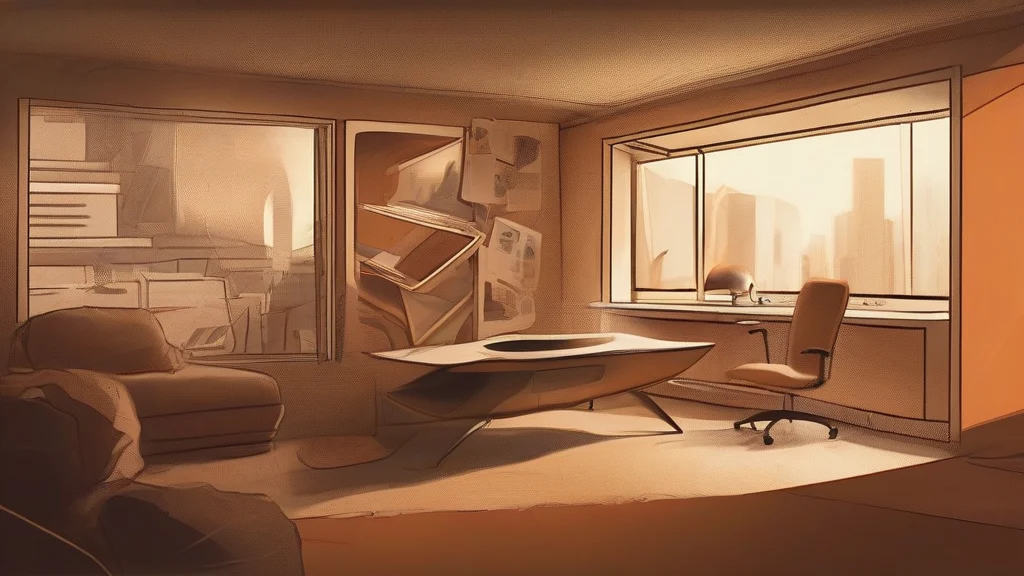
What does cutaway mean?
A cutaway is a representation — typically a drawing, diagram, or scale model — in which part of the outer surface has been deliberately removed so that the interior can be seen. Engineers use cutaways to reveal the inner workings of engines, buildings, and machines, making them a staple of textbooks, manuals, and museum exhibits where understanding hidden structure matters more than outward appearance. In film and television, the term names a brief shot that breaks away from the main action, often showing a listener's reaction or some detail the audience is meant to register. An older, now largely historical sense applies to certain men's coats whose front skirts are tailored away to leave tails at the back. Formed transparently from the verb 'cut' plus the adverb 'away', the word is concrete, practical, and neutral in tone, valued wherever clarity about what lies beneath a surface is required.
A drawing, model, or diagram with a portion of the outer surface removed to display the interior; also, in film, a short shot cutting away from the main scene.
"The engineer sketched a quick cutaway of the gearbox to explain the fault."
Frequently modified by 'view', 'diagram', or 'model' in technical writing.
Having a section cut away to reveal the interior, or (of a garment) tailored with the skirts cut away at the front.
"The exhibition featured an impressive cutaway model of a jumbo jet."
Used attributively before nouns such as 'model', 'view', or 'coat'.
Standard plural; commonly used when discussing multiple shots in film editing or several diagrams.
"The documentary relied heavily on cutaways to maintain pacing during the interview."
That see-through engine diagram on your classroom wall had a name all along: the cutaway.
Reviewed by Deb Chak, Editor. AI-assisted content curated by RJS Tech Solutions LLP.
Etymology of cutaway
Cutaway arose as a straightforward English compound of the verb 'cut' and the adverb 'away', following the pattern of countless native English formations such as 'layout' and 'giveaway'. Its use for diagrams and models showing interiors became established in the nineteenth century alongside technical illustration, while the cinematic sense developed naturally in the twentieth century as filmmaking vocabulary matured. It shares its formation pattern with sibling compounds rather than deriving from any classical root.
How cutaway is actually used
Most common in technical, educational, and engineering contexts for diagrams and models; in journalism and filmmaking it refers to the secondary-shot technique. The sense referring to a style of formal coat is now largely historical or specialized to menswear.
Easily confused with cutaway
A cutoff is a limit, point of stopping, or shortcut, whereas a cutaway reveals an interior by removing an outer layer.