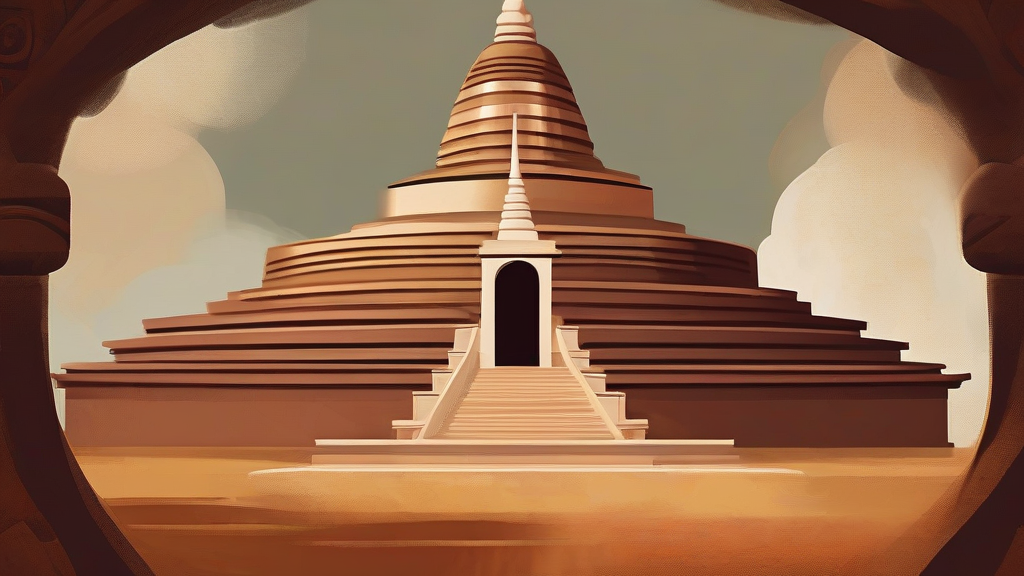
What does dagoba mean?
A dagoba is the distinctive Sri Lankan form of the Buddhist stupa: a solid, hemispherical or bell-shaped monument raised over sacred relics, most often believed to contain remains of the Buddha himself. The great brick dagobas of Anuradhapura and Polonnaruwa rank among the largest ancient structures ever built, and they remain living centres of pilgrimage, where devotees walk clockwise around the dome in an act of devotion known as circumambulation. The word derives ultimately from the Sanskrit phrase dhātu-garbha, meaning 'relic chamber' or 'womb of relics', entering European languages through Sinhalese during the colonial era. Although 'dagoba' is essentially interchangeable with 'stupa', it is preferred when discussing Sri Lanka specifically, while 'stupa' serves as the broader term for such monuments across India, Nepal, Tibet, and Southeast Asia. For readers of archaeology, Buddhist studies, or travel literature, 'dagoba' signals an authoritative familiarity with Sri Lankan religious heritage.
nounA dagoba is a domed Buddhist relic shrine, especially one found in Sri Lanka, housing sacred remains of the Buddha or a revered monk.
- A domed Buddhist monument in Sri Lanka, built over sacred relics, equivalent to a stupa elsewhere in Asia.
"Pilgrims circled the ancient white dagoba at Anuradhapura at dawn."
"Tourists climbed the stone steps to the base of the massive dagoba at Polonnaruwa."
"The monks restored the crumbling dagoba, replastering its whitewashed dome before the full-moon festival."
Standard plural, formed simply by adding -s.
"The plain is dotted with ruined dagobas dating back two thousand years."
The word 'dagoba' literally traces back to a Sanskrit phrase meaning 'relic womb' — the dome was conceived as the container that gestates and protects the Buddha's remains.
Reviewed by Deb Chak, Editor. AI-assisted content curated by RJS Tech Solutions LLP.
Etymology of dagoba
Dagoba derives from the Sinhalese word dāgaba, which descends from the Sanskrit compound dhātu-garbha, literally 'womb' or 'chamber of relics'. European writers adopted the term during the British colonial period in Ceylon (now Sri Lanka), and it entered English dictionaries in the nineteenth century as travellers and archaeologists documented the island's monumental stupas. Its closest relative in general usage is 'stupa', the wider Indic term for the same class of reliquary mound.
How dagoba is actually used
The term is used chiefly in Sri Lankan contexts and in writing about South Asian archaeology and Buddhism; elsewhere 'stupa' is the more general term. It carries scholarly and travel-writing connotations rather than everyday use.
Easily confused with dagoba
A pagoda is a multi-tiered East Asian temple tower, whereas a dagoba is the Sri Lankan dome-shaped stupa form.