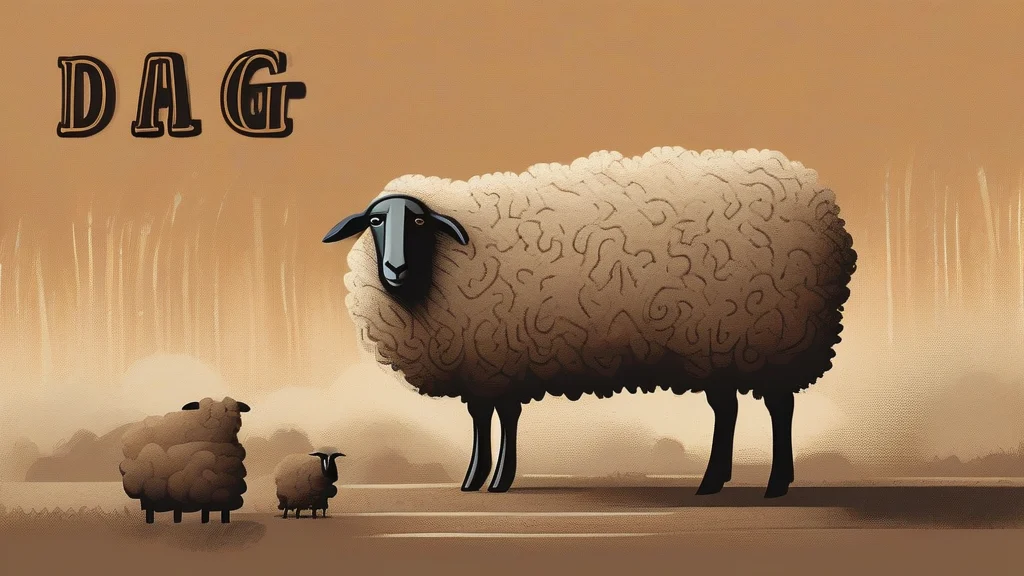
What does dag mean?
A dag is a mass of tangled, dirt- and dung-caked wool that accumulates on the hindquarters of a sheep, particularly around the tail. Dags are a practical nuisance in sheep husbandry: they attract flies, can lead to flystrike, and must be trimmed away before shearing, which is why farmers speak of 'dagging' or 'crutching' a flock. The word belongs chiefly to the rural vocabulary of Britain, Australia, and New Zealand. In Australian and New Zealand slang it has developed a second, affectionate life: to call someone a dag is to say they are unfashionable, quirky, or delightfully unstylish — an endearing oddball rather than an object of contempt. The adjective 'daggy' extends this idea to clothes, jokes, or behaviour that are charmingly out of touch. Though obscure to city dwellers elsewhere, the word is vivid and useful within its home territories, capturing both a concrete feature of farm life and a distinctive attitude toward unpretentious character.
A lump of matted wool mixed with dung and mud hanging from the fleece around a sheep's hindquarters.
"The shearer grumbled about the ewe's heavy dags slowing him down."
Chiefly British, Australian, and New Zealand farming usage.
(Australian and New Zealand slang) An unfashionable, eccentric, or comically uncool person, usually viewed with affection.
"Dad dancing at the wedding in his old cardigan was a complete dag."
Informal and jocular; the connotation is fond rather than harsh.
To trim or clip the dags from a sheep.
"They spent the morning dagging the flock ahead of shearing season."
Rural usage; closely associated with crutching.
The noun pluralises regularly as 'dags'; in the farming sense it is often used of multiple lumps of soiled wool on one or several animals.
"The vet pointed out several dags that would need trimming before summer."
In Australia, calling someone a dag is actually a compliment in disguise — it means they're charmingly unpretentious.
Reviewed by Deb Chak, Editor. AI-assisted content curated by RJS Tech Solutions LLP.
Etymology of dag
The word 'dag' arose as a term of English sheep farming, referring to matted, fouled wool on a sheep's rear; its exact origin is unclear, though it has long been associated with rural dialect vocabulary and may be related to words for clinging or clogging matter. It travelled with British settlers to Australia and New Zealand, where the sheep-farming sense remains in use. There it also acquired the distinctive slang meaning of an amusingly unfashionable person, and the derivative adjective 'daggy'. The word should not be confused with Scandinavian-derived 'dag' meaning 'day', which appears in languages such as Danish and Norwegian but is not part of ordinary English usage.
Related word forms
How dag is actually used
The farming sense is standard rural vocabulary among British, Australian, and New Zealand sheep farmers, and is largely unknown to general urban readers outside those communities. The Australian slang sense of 'a lovably uncool person' is affectionate rather than insulting — it implies lack of polish, not lack of worth. The related adjective 'daggy' describes anything hopelessly unfashionable.
Easily confused with dag
A tag is a small label or dangling attachment fastened to something, whereas a dag is specifically soiled, matted wool on a sheep.
Dog is a common domestic animal; dag differs entirely in meaning despite sharing the same final sound.