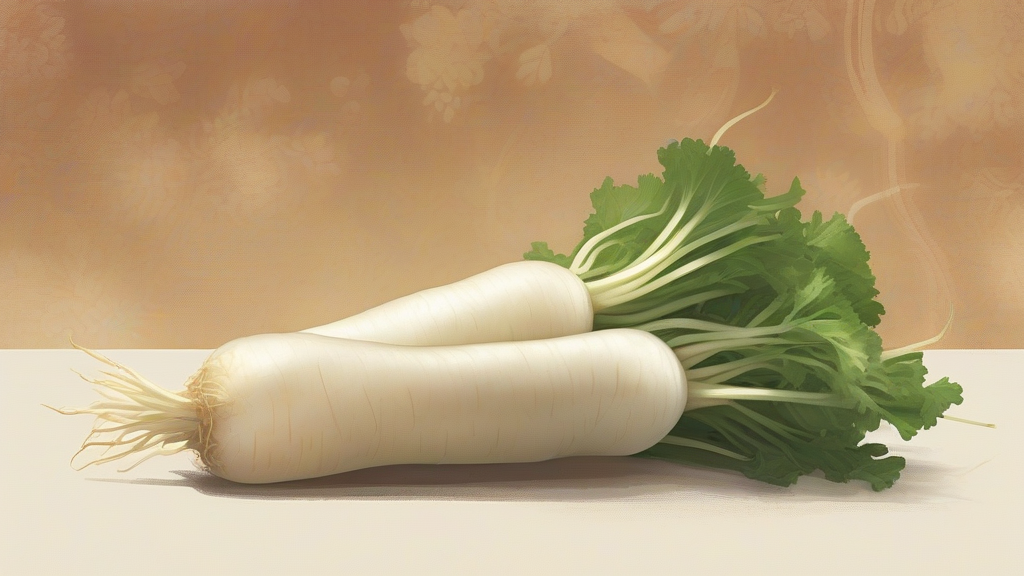
What does daikon mean?
Daikon is a noun denoting a large, white-fleshed winter radish of East Asian origin, botanically a variety of Raphanus sativus. The word comes from Japanese, where it literally combines dai ('large') and kon ('root'). Daikon is far milder than small red radishes, with crisp, juicy flesh and a gentle peppery bite, which makes it versatile: it is eaten raw, grated into sauces, sliced into salads, pickled (as in Japanese takuan), simmered in hot pots such as oden, and added to soups and stir-fries across Chinese, Korean, and Southeast Asian cooking. It is especially prominent in Japanese cuisine, where it is one of the most commonly consumed vegetables. In British English, the same vegetable is often called mooli, reflecting South Asian usage. For cooks and readers of food writing, daikon is a familiar, useful term for identifying and preparing this distinctive root vegetable.
nounA large, long white winter radish of East Asian origin, with a mild flavour, widely used in the cuisines of Japan, China, and Korea.
- A large white East Asian radish (Raphanus sativus var. longipinnatus) eaten raw, pickled, or cooked.
- The edible root of this plant as an ingredient in cooking.
"She grated fresh daikon into the dipping sauce to serve alongside the tempura."
"Thinly sliced daikon adds a crisp, peppery note to a Vietnamese banh mi sandwich."
"Simmered daikon is a staple of Japanese oden and other winter hot-pot dishes."
In everyday and culinary use daikon is frequently uncountable, like many vegetable names; 'daikons' appears when counting individual roots.
"He bought three daikons at the market for the pickle batch."
The word 'daikon' literally means 'big root' in Japanese — and at over two feet long, this radish lives up to its name.
Reviewed by Deb Chak, Editor. AI-assisted content curated by RJS Tech Solutions LLP.
Etymology of daikon
The word daikon entered English from Japanese 大根 (daikon), literally meaning 'large root', during the late nineteenth century as trade and cookery books introduced East Asian vegetables to Western audiences. It is ultimately related to the Chinese term for the same radish, luóbo, though the words are not cognates in the strict sense. In British English the parallel borrowing mooli came via Hindi and Urdu from Sanskrit mūlaka, meaning radish.
How daikon is actually used
Daikon is a culinary term borrowed from Japanese and is used mainly in food writing, recipes, and grocery contexts. In British English the word mooli is often used for the same vegetable. The plural is typically 'daikon' when referring to the vegetable as produce, though 'daikons' is also accepted.
Easily confused with daikon
Mooli is simply the South Asian name for essentially the same large white radish that the Japanese call daikon.