
What does dairymaid mean?
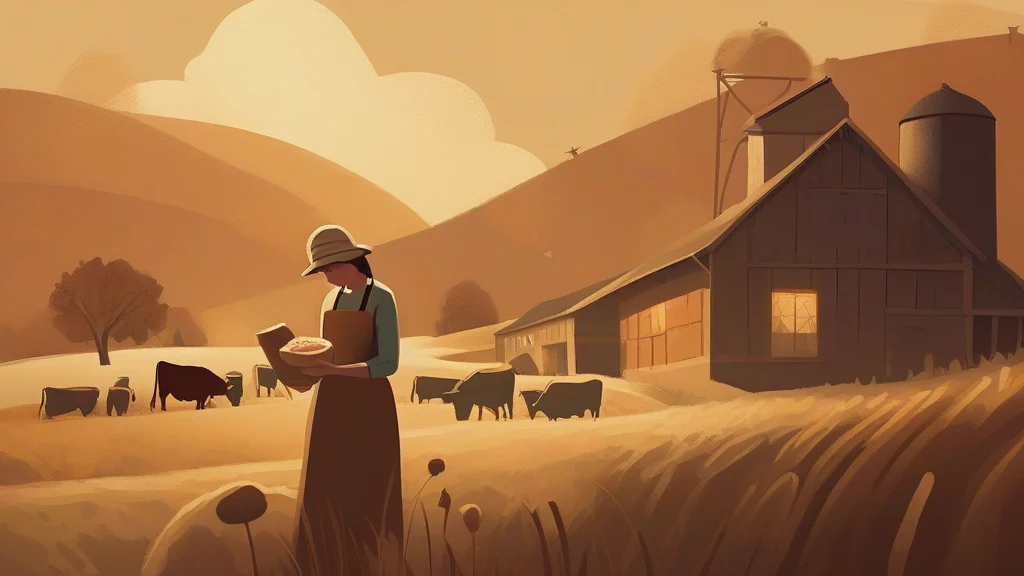
A dairymaid is a woman or girl employed to work in a dairy, historically on a farm, where her duties included milking cows, churning butter, and making cheese. The term combines 'dairy' — from Middle English 'deyerie', referring to a place where milk is processed — with 'maid', an old word for a young woman or female servant. Dairymaids were central figures in rural economies before industrialisation, and their work was physically demanding, beginning before sunrise. The word is now largely historical in register, evoking pastoral scenes and appearing frequently in literature, most famously in Thomas Hardy's Tess of the d'Urbervilles. Its masculine counterpart is dairyman. In modern usage, the gender-neutral term 'dairy worker' has largely replaced it, but dairymaid survives in historical writing, heritage contexts, and discussions of traditional farming life.
nounA woman or girl employed to work in a dairy, typically milking cows and making butter and cheese on a farm.
- A female worker in a dairy, responsible for tasks such as milking cows, churning butter, and making cheese.
"The dairymaid rose before dawn to begin churning the morning's butter."
"In Thomas Hardy's Tess of the d'Urbervilles, Tess works as a dairymaid at Talbothays Dairy."
"The old farmhouse still displays the wooden stool the dairymaid used while milking."
The standard plural simply adds -s; there are no irregular forms.
"The dairymaids sang as they worked in the cool stone dairy."
Before refrigeration, the dairymaid was the beating heart of the farm — milking at dawn, churning by noon — and her skill with butter was once so prized that 'dairymaid' appears in countless folk tales and paintings.
Reviewed by Deb Chak, Editor. AI-assisted content curated by RJS Tech Solutions LLP.
Etymology of dairymaid
The word 'dairymaid' is formed from 'dairy', which derives from Middle English 'deyerie', originally denoting a place where milk is kept and made into butter and cheese, combined with 'maid', meaning a young unmarried woman or female servant. The compound arose in English during the early modern period as dairy farming became a specialised occupation on farms. It parallels other compounds such as 'milkmaid' and 'dairyman'.
Related word forms
How dairymaid is actually used
The word is somewhat dated and carries a rustic, historical connotation; 'milkmaid' is often used interchangeably, though some sources distinguish a dairymaid (working indoors on butter/cheese) from a milkmaid (milking). Today the gender-neutral term 'dairy worker' is more common.
Easily confused with dairymaid
A dairyman is a man who works in a dairy, while a dairymaid is a woman or girl doing the same work.