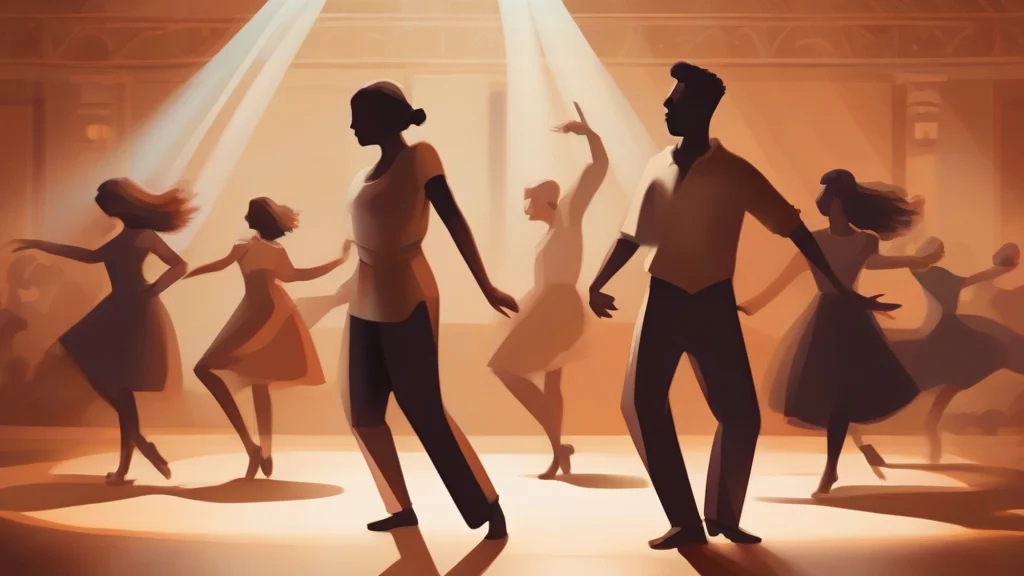
What does dancey mean?
"Dancey" is an informal English adjective used almost exclusively to describe music that invites movement — songs with an insistent beat, driving bassline, or energetic groove that make listeners want to get up and dance. A critic might call a remix "danceier" than the original, or note that an album's second half turns unexpectedly dancey. The word is formed simply from "dance" plus the adjectival suffix "-y," and it appears mainly in music journalism, playlist descriptions, reviews, and everyday conversation about pop, electronic, disco, and club music. Its connotation is reliably positive: describing a track as dancey suggests it is lively, fun, and physically compelling rather than merely loud or fast. Because it is colloquial, it seldom appears in formal prose, where phrases such as "rhythmic," "up-tempo," or "suitable for dancing" are preferred instead. A common variant spelling, "dancy," means the same thing, though "dancey" is more frequently encountered in published reviews and online writing.
adjective(informal) Having a rhythm, beat, or quality that makes something suitable for dancing; lively and dance-like in character.
- (of music) having a strong, infectious rhythm suited to dancing
- (more generally) lively or animated in a dance-like way
"The DJ closed the set with a dancey remix that got everyone back on the floor."
"Her new single is slower than her earlier work but still unmistakably dancey."
"The band swapped their usual ballads for something shorter and danceier to close the show."
"Dancey" isn't in most print dictionaries yet — but it's exactly the word DJs and music critics reach for when a track makes sitting still impossible.
Reviewed by Deb Chak, Editor. AI-assisted content curated by RJS Tech Solutions LLP.
Etymology of dancey
"Dancey" is a straightforward English formation combining the verb and noun "dance" with the familiar adjectival suffix "-y," producing a word meaning "having the qualities of dance." The root word "dance" entered Middle English in the late medieval period, borrowed from Old French "dancier," whose own deeper origins remain uncertain, though Germanic roots have been proposed. As a modern colloquial coinage, "dancey" emerged in twentieth-century popular usage alongside the growth of recorded dance music and club culture, and it remains largely absent from major printed dictionaries despite its widespread use in music criticism.
How dancey is actually used
"Dancey" is informal and belongs chiefly to music journalism, reviews, and casual conversation about pop, electronic, and club music. It carries a positive connotation — calling a track "dancey" usually implies it is energetic and appealing. It is rarely used in formal writing, where "suitable for dancing" or "rhythmic" would be preferred.
Easily confused with dancey
"Dancy" is a variant spelling of the same word; "dancey" with the e is the more common form.