What does daphnia mean?
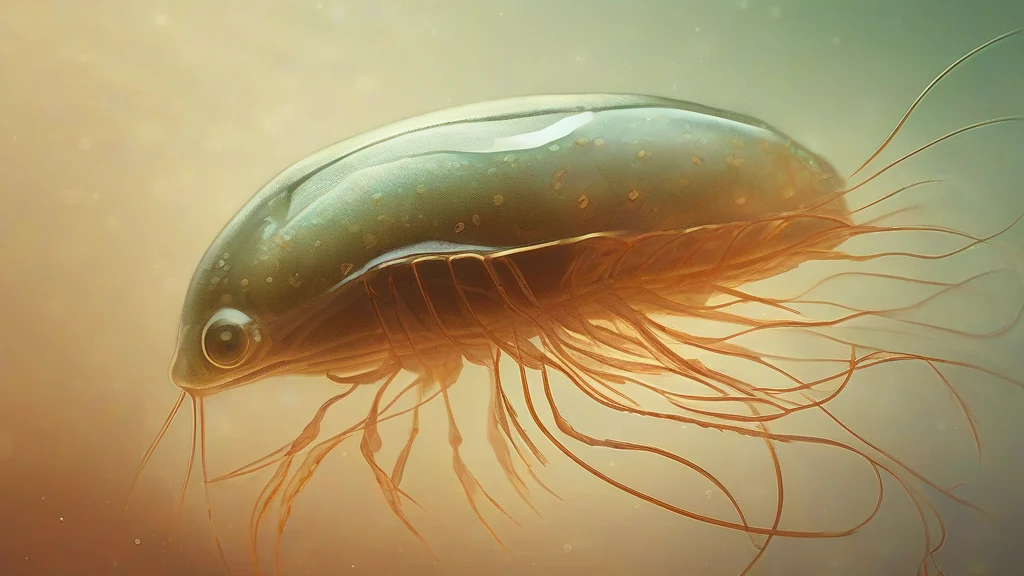
Daphnia refers to any member of a genus of minute, mostly transparent freshwater crustaceans belonging to the order Cladocera. Commonly known as water fleas because of their small size and jerky, hopping swimming style, they drift through ponds, lakes, and slow streams, feeding by filtering algae and other fine particles from the water. Though barely visible to the naked eye, daphnia occupy a crucial position in aquatic food webs, linking microscopic producers to fish and other predators. Their transparency makes internal organs such as the beating heart easy to observe, which has made them a classic subject for biology classes and a standard model organism in ecotoxicology: researchers expose daphnia populations to chemicals to gauge environmental risk. The word is used mainly in scientific and educational contexts, while "water flea" serves as its everyday equivalent.
nounA tiny freshwater crustacean of the genus Daphnia, commonly called a water flea, that swims with jerky movements and filters algae and other particles from the water. It is widely used in scientific research, particularly in ecology and toxicology.
- Any small planktonic freshwater crustacean of the genus Daphnia (order Cladocera), known as a water flea.
- (In scientific contexts) a standard model organism used in toxicity testing and ecological research.
"The students counted the daphnia under the microscope to measure how the pollutant affected their heart rate."
"The pond water was teeming with daphnia, visible only as faint specks darting through the sample."
"Because daphnia reproduce rapidly and respond sensitively to contaminants, they are a staple organism in aquatic toxicity testing."
The plural is normally identical to the singular, especially in scientific writing; "daphnias" is an occasional informal variant.
"We introduced fifty daphnia into each beaker to begin the experiment."
Scientists watch the transparent heart of a daphnia beating under a microscope to test whether chemicals are safe — one tiny 'water flea' can flag toxins for entire ecosystems.
Reviewed by Deb Chak, Editor. AI-assisted content curated by RJS Tech Solutions LLP.
Etymology of daphnia
The name daphnia comes from New Latin, the formal language of scientific naming, and derives ultimately from the ancient Greek word daphnē, meaning "laurel," also borne by the mythological nymph Daphne. It was coined when naturalists established the genus Daphnia during the development of modern zoological classification in the eighteenth century. The same Greek root gives us related words such as the plant name daphne.
How daphnia is actually used
Daphnia is primarily a technical and scientific term; in everyday speech most people say "water flea." It is both the common singular/plural form in informal use and the formal genus name, which in strict zoological usage is capitalized as Daphnia. The plural is usually left unchanged, though "daphnias" occasionally appears.
Easily confused with daphnia
Daphne is a shrub of the laurel family (and a figure in Greek myth), whereas daphnia is a microscopic freshwater crustacean.