What does deadeye mean?
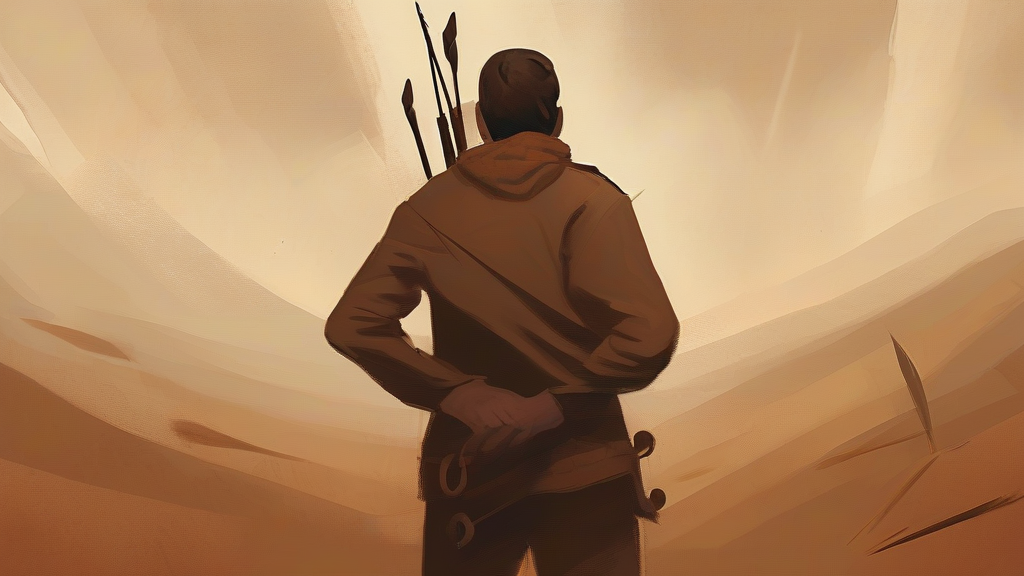
A deadeye is, most commonly, a person with remarkably accurate aim — a sharpshooter who seems never to miss. The word carries an admiring, slightly folksy connotation and appears frequently in descriptions of marksmen, athletes, and arcade champions alike. Less familiar to most modern readers is its older nautical meaning: a deadeye is a rounded wooden block, pierced with holes and grooved around its edge, that sailors paired with a matching block and lanyard to tension the standing rigging of sailing vessels. The nautical sense predates the shooting sense, and both senses share the straightforward logic of the compound — something 'dead' true, steady, or fixed. Today the marksman sense dominates everyday usage, while the rigging sense survives among sailors, historians, and ship restorers. Whether praising a basketball player's flawless free throws or describing the tackle of a tall ship, deadeye conveys precision, steadiness, and reliability under pressure.
A person who shoots or throws with unerring accuracy.
"Every team wanted him on board once they saw what a deadeye he was from beyond the arc."
Informal and admiring; applied figuratively beyond firearms to any activity requiring pinpoint accuracy.
In nautical use, a round wooden block with a hole or holes through it, used in pairs with a lanyard to tension rigging.
"The rigger replaced the cracked deadeye before the ship could safely set sail."
Technical maritime vocabulary; typically found in plural pairs working together in traditional rigging systems.
Regular plural; especially common in the nautical sense, where deadeyes are always used in pairs.
"The shrouds were secured with tarred lanyards running through pairs of deadeyes."
Before ships had turnbuckles, sailors kept their rigging tight using pairs of wooden discs called deadeyes — and the name later stuck to anyone whose aim was just as reliable.
Reviewed by Deb Chak, Editor. AI-assisted content curated by RJS Tech Solutions LLP.
Etymology of deadeye
Deadeye is an English compound formed from the native words "dead" and "eye." The nautical sense arose first, attested by at least the late sixteenth century, when the round rigging block was likened to a human eye through which ropes passed; some accounts suggest the dark holes gave the impression of a lifeless eye. The marksman sense developed later from the notion of a shooter whose aim is "dead" — unerringly certain — and became popular in nineteenth-century American frontier speech. Both elements are common Germanic words, so the word's cognates are simply other English compounds built from the same two roots.
How deadeye is actually used
The marksman sense is informal and often affectionate or admiring in tone. The nautical sense is technical, appearing mainly in sailing and maritime contexts; it refers specifically to wooden blocks used in traditional rigging.
Easily confused with deadeye
"Dead eye" written as two words can describe a lifeless or expressionless stare, whereas "deadeye" as one word refers either to an expert marksman or to the nautical rigging block.
A bull's-eye is the center of a target itself (or a hit there), while a deadeye is the skilled shooter who reliably hits it.