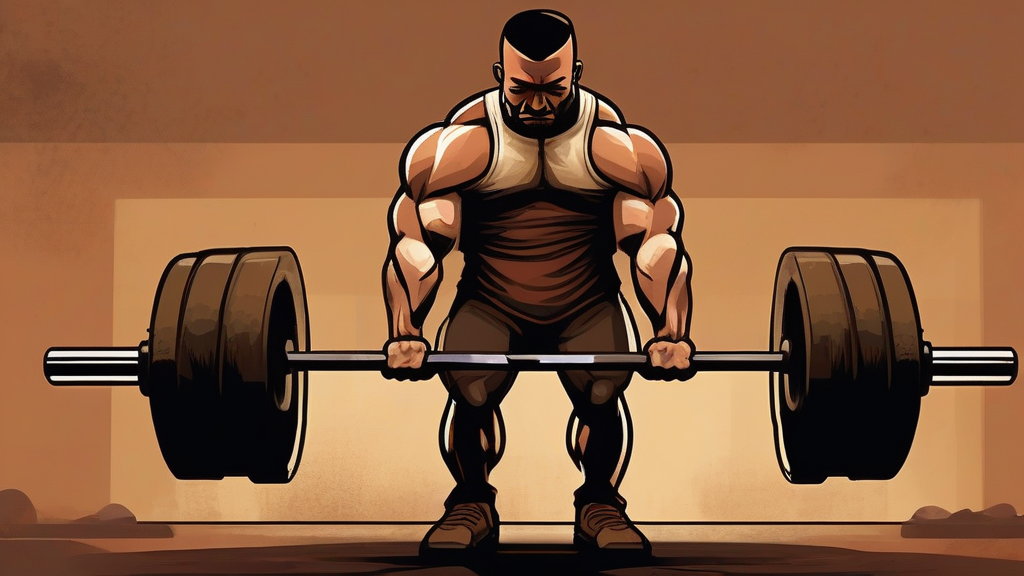
What does deadlift mean?
The deadlift is one of the foundational exercises in modern strength training: a movement in which the lifter raises a loaded barbell from the floor to a standing position, then lowers it back down under control. Its name comes from the fact that the weight starts at rest—"dead"—so every part of the lift must be generated by the lifter's own force, unlike a squat or bench press where momentum can assist. The deadlift primarily develops the posterior chain, including the hamstrings, glutes, spinal erectors, and grip, which has made it a staple for athletes and recreational gym-goers alike. It also holds a central place in the sport of powerlifting, where it is one of the three contested lifts alongside the squat and bench press. Variants such as the sumo and Romanian deadlift adjust stance or range of motion, but all share the core idea: lifting dead weight off the ground with proper technique.
A weightlifting exercise, and a competitive event in powerlifting, in which a loaded barbell is raised from the ground to a standing position and then lowered again, chiefly developing the legs, hips, back, and grip.
"Her deadlift improved dramatically once she learned to brace her core properly."
Often pluralized when referring to multiple repetitions: "five heavy deadlifts."
To raise a barbell from the ground to a standing position using the technique of the deadlift exercise.
"She deadlifted twice her bodyweight at the regional meet."
Regular inflection: deadlifts, deadlifting, deadlifted.
The plural typically denotes repetitions of the exercise or distinct variants such as sumo and Romanian deadlifts.
"Three sets of five deadlifts finished off her workout."
Unlike most exercises named after muscles or machines, the deadlift takes its name from the simple fact that you're lifting 'dead' weight — a motionless barbell that must be raised entirely under your own power.
Reviewed by Deb Chak, Editor. AI-assisted content curated by RJS Tech Solutions LLP.
Etymology of deadlift
The word "deadlift" is a compound of "dead," meaning lifeless or motionless, and "lift," from Old Norse "lypta," meaning to raise or hoist. It arose in English in the context of physical training, gaining widespread use as organized weightlifting and later powerlifting developed through the twentieth century. The element "lift" connects the word to a broader family of raising-related terms borrowed or built from the same Norse source, such as "airlift" and "forklift." Its literal logic—that one lifts weight that is not moving—has kept the term stable and unambiguous since its adoption.
How deadlift is actually used
"Deadlift" is used both as a noun for the exercise itself and as a verb ("she deadlifted 150 kilos"). In fitness contexts it is everyday register; in formal writing about sport science it appears freely without quotation marks. The plural "deadlifts" commonly refers either to repetitions performed or to variants of the exercise (e.g., sumo deadlifts, Romanian deadlifts).
Easily confused with deadlift
The squat starts with the weight held across the shoulders or upper back, whereas the deadlift begins with the weight resting on the ground.