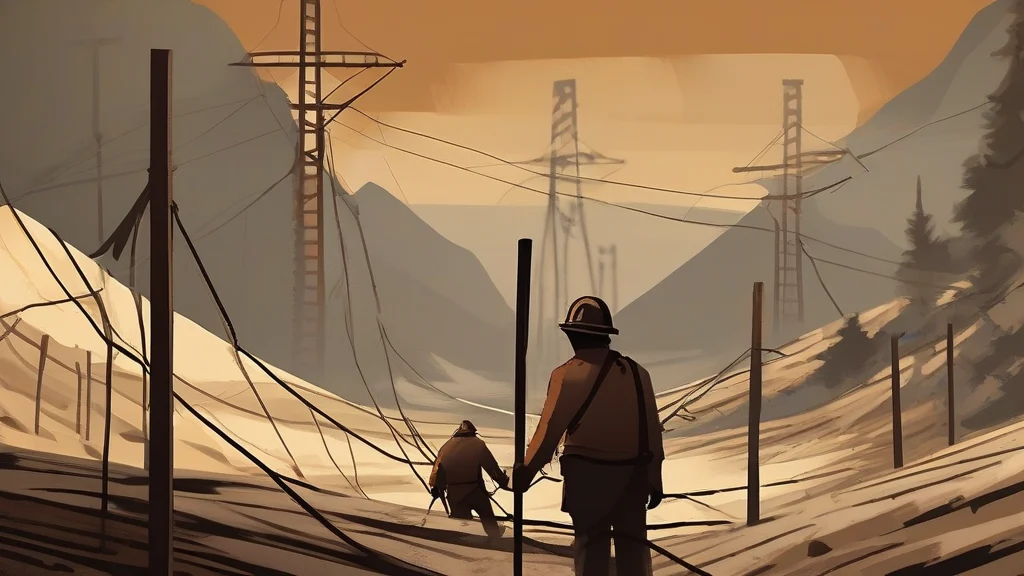
What does deadmen mean?
A deadman — plural deadmen — is a heavy object such as a block of timber, concrete, or steel buried in the ground so that it can serve as a secure anchorage. Because it is concealed below the surface, the surrounding earth presses down on it, giving it enough resistance to hold guy-wires, stays, tiebacks, or the tendons of a retaining wall under considerable tension. The word appears most often in civil engineering, construction, and rigging contexts: engineers might specify concrete deadmen for a seawall, or crews might set timber deadmen to brace fence posts or support a mast. The name is thought to evoke the inert, buried nature of the object rather than anything morbid. Though unfamiliar to most lay readers, the term is precise and well established in its field, and it offers a vivid example of how technical vocabulary often borrows plain, striking words from everyday language.
nounA heavy object, such as a timber or concrete block, buried in the ground to serve as an anchor for guy-wires, stays, or cables. In mountaineering and engineering, it can also refer to any buried or wedged object used as an anchorage.
- A heavy object (typically timber, concrete, or steel) buried in the ground to anchor guy-wires, stays, tiebacks, or retaining structures.
- An object wedged into rock or terrain to serve as an anchoring point in mountaineering or rigging.
"The workers sank several concrete deadmen into the hillside to anchor the retaining wall's tiebacks."
"Engineers embedded rows of deadmen behind the seawall to resist the lateral pressure of the earth."
"The old fence posts were braced with timber deadmen set deep in the clay."
Standard plural, formed irregularly as men (like 'dead man' → 'deadmen'); the plural is common because anchors are usually installed in groups.
"The crew installed twelve deadmen to secure the guy-wires of the radio mast."
Despite its grim name, a 'deadman' is very much alive in construction — it's the hidden block of timber or concrete quietly holding bridges, walls, and masts upright from beneath the soil.
Reviewed by Deb Chak, Editor. AI-assisted content curated by RJS Tech Solutions LLP.
Etymology of deadmen
The compound combines 'dead' with 'man' in a sense common in English technical vocabulary, where 'man' denotes a device or object functioning as an agent — as in 'dead man's switch'. It arose in British and American construction and engineering usage, likely in the 19th century, describing an object that lies inert and buried like a corpse yet performs vital work. Its components are thoroughly native Germanic words ('dead' from Old English 'dēad', 'man' from Old English 'mann'), making this a fully Germanic formation rather than a borrowing.
Related word forms
How deadmen is actually used
The term is technical, used mainly in civil engineering, construction, and rigging contexts; it is rarely encountered in everyday speech. The singular form is 'deadman'.
Easily confused with deadmen
A dead man's switch is a safety device that stops machinery when the operator releases it, whereas a deadman is a physical anchor buried in the ground.