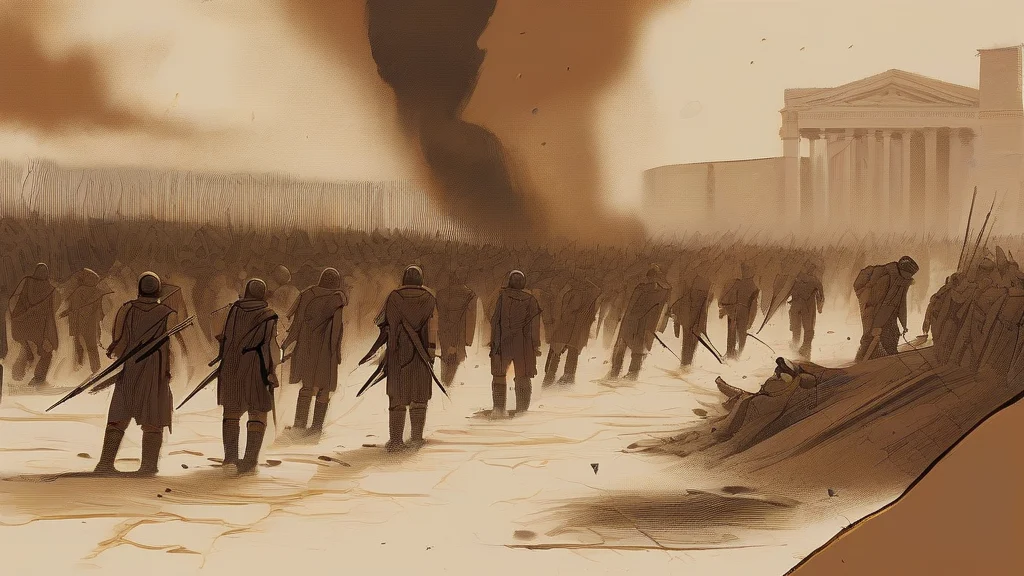
What does decimation mean?
Decimation refers to the destruction or drastic reduction of a group, population, or resource — for example, the decimation of a species by habitat loss or the decimation of an army in battle. The word originates from the Latin decimatio, from decimus ('tenth'), and originally described a brutal Roman military punishment: if a unit was guilty of mutiny or cowardice, one soldier in every ten was executed, chosen by lot. In modern English the literal 'tenth' sense has largely faded, and decimation is used broadly to mean severe depletion or widespread destruction, though some traditionalists still prefer to reserve it for losses close to a tenth. It carries a strongly negative connotation and appears mostly in formal writing and journalism, particularly in discussions of war, disease, ecology, and economic collapse.
nounThe killing, destruction, or removal of a large proportion of a group or thing; historically, the execution of one in every ten soldiers in a Roman military unit as punishment for collective offenses.
- The destruction or drastic reduction of a group, population, or resource (e.g., 'the decimation of wildlife habitats').
- Historical: the Roman military practice of killing one in ten soldiers in a unit as collective punishment for mutiny or cowardice.
"The decimation of the bee population threatens the entire agricultural ecosystem."
"The decimation of the rainforest has driven countless species to the brink of extinction."
"Under Roman discipline, a cohort found guilty of cowardice might face decimation, with lots determining which tenth would die."
Rarely used in the plural; the noun is almost always treated as uncountable when referring to destruction, though plural forms occasionally appear in historical contexts describing multiple instances of the Roman punishment.
"The annals record several decimations carried out against legions that broke under pressure."
In ancient Rome, 'decimation' meant executing every tenth soldier in a mutinous legion — a punishment so brutal it was rarely used.
Reviewed by Deb Chak, Editor. AI-assisted content curated by RJS Tech Solutions LLP.
Etymology of decimation
Decimation comes from the Latin decimatio, formed on decimus ('tenth'), which itself derives from the Indo-European root *dekm ('ten'). In ancient Rome, decimatio was a punitive practice in which a military unit guilty of serious offences had one man in ten executed by lot. The word entered English in the late sixteenth or early seventeenth century, initially retaining its historical military sense before broadening over time to mean the destruction or heavy reduction of any group. Cognates sharing the same Latin root include decimal, decimate, and December (originally the tenth month of the Roman calendar).
Related word forms
How decimation is actually used
Though derived from Latin 'decimus' meaning 'tenth', 'decimation' is now widely used to mean severe reduction or destruction of any proportion, not literally one-tenth. Some purists object to this broadened usage, but it is fully standard in modern English. The word carries a strongly negative connotation and is typically used in formal or journalistic registers.
Easily confused with decimation
Strictly, decimation implies the loss of roughly a tenth (or at least a significant proportion) of something, whereas devastation implies complete or near-complete destruction.