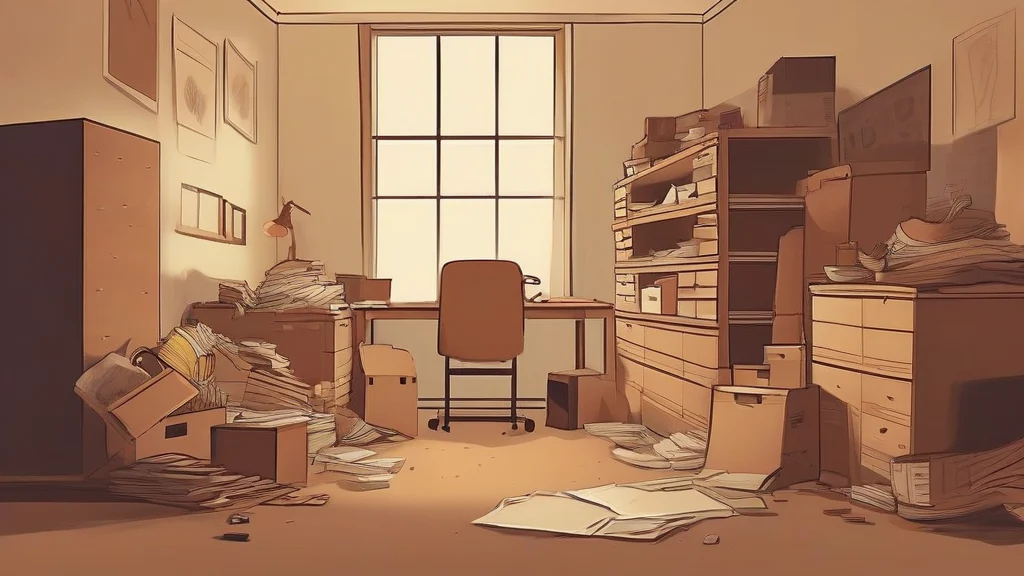
What does declutter mean?
To declutter is to remove superfluous or disordered items from a space — a drawer, a room, an entire house — leaving it tidier, simpler, and easier to use. The verb pairs the prefix "de-", indicating removal or reversal, with "clutter", an English word for a confused mass of things. Although its roots are old, "declutter" itself is a relatively recent coinage that rose sharply in popularity during the late twentieth century alongside home-organisation advice and, later, the minimalist movement. It is most often used transitively, as in "declutter the garage" or "declutter your wardrobe", but it extends naturally beyond physical spaces: people speak of decluttering their schedules, their inboxes, even their minds. The word carries warm connotations of order, clarity, and deliberate living, and its cultural prominence owes much to tidying experts who turned clearing out possessions into a philosophy. Few everyday verbs so neatly capture the modern desire to own less and live more.
verbTo remove unnecessary items or mess from a place in order to make it tidier and more organised; more broadly, to simplify or clear away excess from one's life or commitments.
- To remove clutter or unnecessary items from a room, house, or other physical space so as to make it tidy.
- To rid one's life, schedule, or mind of excess activities, commitments, or distractions.
"She spent the whole weekend decluttering the garage before the move."
"Before putting the flat on the market, they spent two weeks decluttering every room."
"He deleted forty apps and unsubscribed from a dozen newsletters, determined to declutter his digital life."
A word barely a few decades old, "declutter" went from niche self-help jargon to a global obsession — largely thanks to tidying consultants telling millions of people to thank their socks before throwing them away.
Reviewed by Deb Chak, Editor. AI-assisted content curated by RJS Tech Solutions LLP.
Etymology of declutter
The word "declutter" is formed from the prefix "de-", indicating removal or reversal, combined with "clutter", which derives from Middle English "clotter", related to "clot" and originally suggesting congealed or coagulated matter before shifting to mean a disorderly heap of things. "Clutter" itself dates back to at least the sixteenth century in its modern sense, while the prefixed form "declutter" emerged much later, gaining real currency only in the late twentieth century as professional organising became an industry.
Related word forms
How declutter is actually used
The word is informal-to-neutral in register and carries strongly positive connotations of order, calm, and intentional living, having been popularised by the modern minimalism and home-organisation movements. It is typically used transitively with a place or domain as object ("declutter the kitchen", "declutter your inbox") but also appears intransitively ("time to declutter").
Easily confused with declutter
"Clutter" refers to the untidy mess itself or the act of filling a space with it, whereas "declutter" means removing that mess.
"Unclutter" is an older synonym meaning to free a space of clutter; "declutter" has largely displaced it and also carries the extended sense of simplifying one's life.