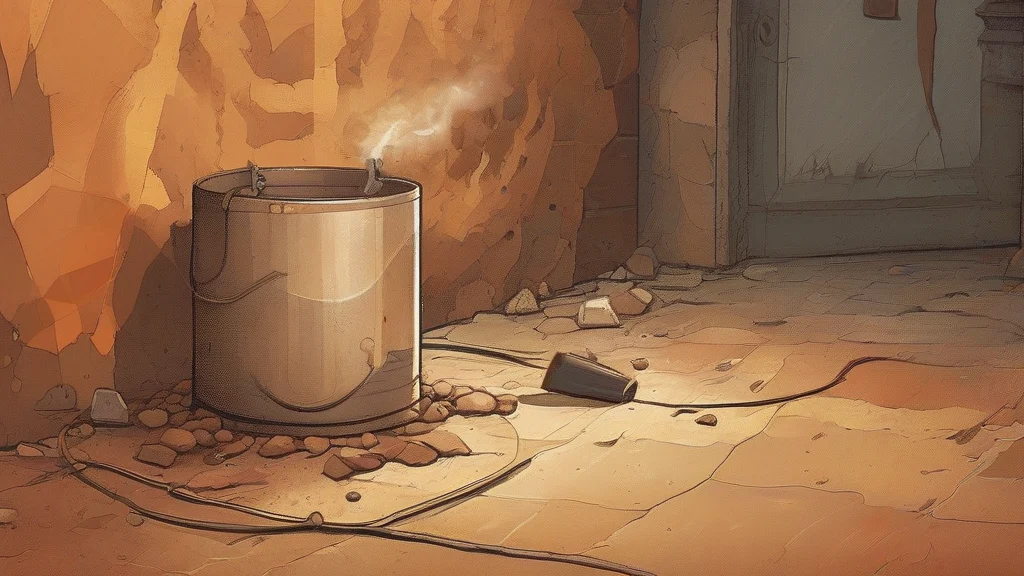
What does decrepitate mean?
To decrepitate is to produce a series of small, sharp cracking or popping sounds — the snap and sputter of burning twigs, hot stones, or damp logs. The verb also survives in a more specialized chemical sense: heating a crystalline substance, usually a salt containing water of crystallization, until the crackling caused by escaping moisture dies away, at which point the substance is said to be decrepitated. This second sense gives rise to the noun "decrepitation," familiar mainly from older laboratory manuals and the mineralogical "decrepitation test." Derived from Latin decrepitare, built on crepare, "to creak or crack," the word is a close cousin of "crepitate." Rare in modern speech, it lends a precise, faintly technical flavor to descriptions of sound, and it rewards writers who want an exact term for that particular stuttering crackle rather than a generic noise.
verbTo crackle, or to make a series of small cracking or popping sounds; in chemistry and older usage, to roast a substance (especially a salt) until it stops crackling as its water of crystallization is driven off.
- To make small cracking or popping sounds.
- (Chemistry, chiefly historical) To heat a crystalline substance, typically a salt, until it no longer crackles owing to the loss of water of crystallization.
"The damp logs decrepitated loudly in the grate as the fire took hold."
"The old floorboards decrepitated underfoot as he crossed the darkened hall."
"In the classic laboratory demonstration, the crystals decrepitate violently before settling into silence."
Chemists once judged whether a salt was dry by listening for the moment it stopped singing — when the popping ceased, they said it had 'decrepitated.'
Reviewed by Deb Chak, Editor. AI-assisted content curated by RJS Tech Solutions LLP.
Etymology of decrepitate
English adopted "decrepitate" in the seventeenth century from Latin decrepitare, meaning to crackle or creak repeatedly, itself formed on crepare, "to rattle, crack, or creak." The same Latin root produced "crepitate," "decrepit" (originally "worn out with age," as if creaking), and "discrepant" (literally "sounding apart"). The chemical sense developed later among early chemists who observed salts crackling as their water of crystallization escaped under heat.
Related word forms
How decrepitate is actually used
A rare, formal, or technical word. The chemical sense appears mostly in older textbooks and mineralogy, where the "decrepitation test" was used to detect water of crystallization; the general sense of crackling is literary rather than everyday.
Easily confused with decrepitate
"Crepitate" means simply to crackle or make a rattling sound, while "decrepitate" additionally carries the technical sense of roasting a substance until crackling ceases.
"Decerebrate" refers surgically to removing or disconnecting the cerebrum and has nothing to do with crackling sounds despite the similar beginning.