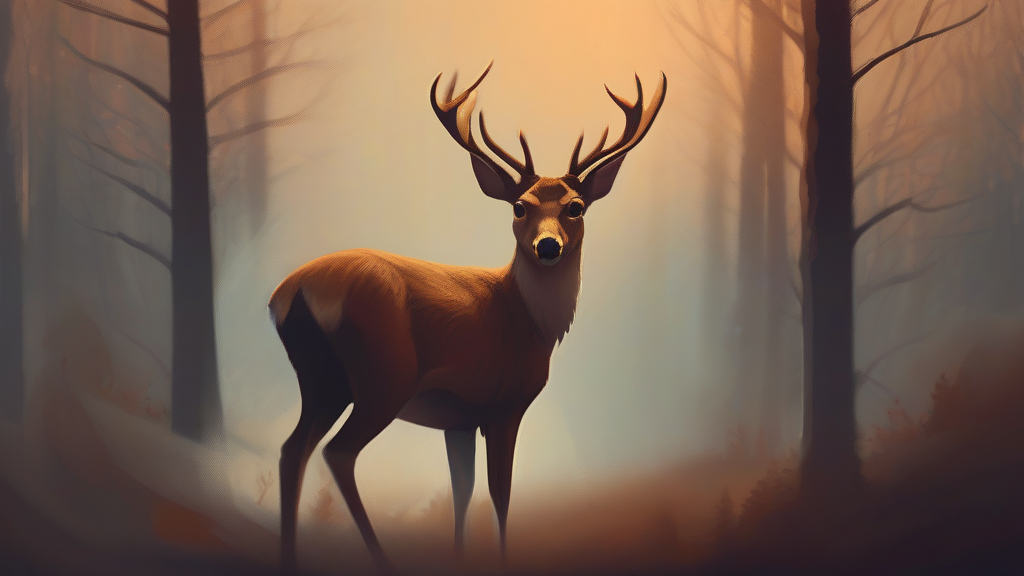
What does deerlike mean?
"Deerlike" is an adjective used to describe something that resembles or evokes a deer — most often a person's movement, appearance, or manner. It typically suggests gracefulness and lightness of step, as in a dancer's deerlike poise, but it can equally convey shyness, wide-eyed innocence, or a tendency to startle easily, as when someone casts a deerlike glance before retreating. Because deer combine beauty with wariness, the word sits comfortably between admiration and gentle observation, making it a favorite of literary and journalistic description. Formed by attaching the familiar suffix "-like" to "deer," it is transparent in meaning and requires little explanation, yet it remains relatively rare in everyday speech, lending descriptive writing a slightly elevated, evocative tone. It is a useful word for writers seeking to capture a delicate, elusive quality that plainer adjectives such as "shy" or "graceful" fail to fully convey.
adjectiveResembling or characteristic of a deer, especially in being graceful, shy, timid, or fleet-footed.
- Resembling or characteristic of a deer in appearance, movement, or temperament, especially in conveying gracefulness, shyness, or timidity.
"She moved across the stage with a deerlike lightness that held the audience spellbound."
"The dancer's deerlike movements made her the natural choice for the role."
"He gave her a deerlike glance and slipped quietly out of the room."
In Old English, "deor" simply meant any wild animal — which means "deerlike" originally pointed at beastliness, not gentleness.
Reviewed by Deb Chak, Editor. AI-assisted content curated by RJS Tech Solutions LLP.
Etymology of deerlike
"Deerlike" is a straightforward English compound of "deer" and the adjectival suffix "-like." The noun "deer" derives from Old English "dēor," which in that period meant any wild animal rather than specifically the animal we now call a deer — a narrowing of sense that developed over the Middle English period. It descends from Proto-Germanic *deuzą, shared with cognates such as German "Tier" (animal). The "-like" suffix, from Old English "gelīc," has long been productive in forming adjectives of resemblance, so "deerlike" follows a well-established pattern of comparison in English.
How deerlike is actually used
"Deerlike" is a literary rather than everyday adjective, most often used descriptively of people or animals to evoke grace, wide-eyed innocence, or nervous timidity. It carries a broadly positive or gently neutral connotation; context determines whether it emphasizes beauty or wariness.
Easily confused with deerlike
"Dear" is an adjective or noun of affection and endearment, while "deer" refers to the hoofed animal — the two are homophones but entirely unrelated in meaning.