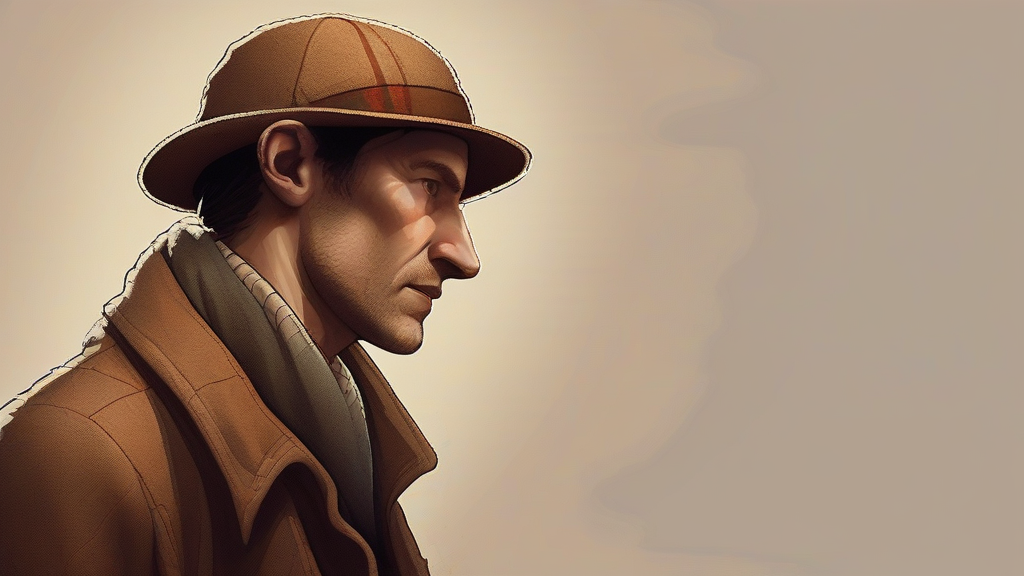
What does deerstalker mean?
A deerstalker is a soft cap made typically of tweed or other woollen cloth, distinguished by having a visor at both the front and back together with ear flaps that can be fastened over the ears or tied up on top of the crown when not needed. As its name suggests, it was originally designed as practical headwear for hunting deer — hence 'deer' plus 'stalker', one who stalks game quietly — offering warmth, protection, and coverage useful in cold, damp countryside conditions. Though still worn by hunters and country sportsmen, especially in Britain, the word today is most strongly associated with Sherlock Holmes, whose image is inseparable from the deerstalker even though Arthur Conan Doyle never mentions such a hat in his stories. In modern usage the term is concrete and informal, referring either to the garment itself or to its role as an instantly recognisable emblem of detective fiction and Victoriana. It is a countable noun with the regular plural 'deerstalkers'.
nounA soft cap with a visor at both the front and back and ear flaps that can be tied up on the crown, traditionally worn for hunting deer; it is now best known as the iconic headwear associated with Sherlock Holmes.
- A hunting cap of wool or tweed with a brim at both front and back and ear flaps tied above the crown.
- The hat popularly associated with Sherlock Holmes as a symbol of the detective.
"The old gentleman arrived at the costume party in tweeds, a pipe, and a deerstalker perched atop his head."
"He pulled his deerstalker down over his ears against the biting wind."
"On the book's cover, the detective peers out from beneath his familiar deerstalker."
Regular plural; used both for multiple hats and generically for wearers of them.
"The shop displayed a row of deerstalkers in various shades of tweed."
Sherlock Holmes is never described wearing a deerstalker in any of Conan Doyle's stories — the famous hat was invented entirely by illustrator Sidney Paget.
Reviewed by Deb Chak, Editor. AI-assisted content curated by RJS Tech Solutions LLP.
Etymology of deerstalker
Deerstalker is a transparent English compound formed from 'deer' (Old English dēor) and 'stalker', the agent noun from the verb 'stalk', meaning to pursue game stealthily. It arose in nineteenth-century Britain as the name of the cap worn by hunters pursuing deer, with the earliest attestations dating to around the mid-1800s. Its cultural prominence was cemented in the late nineteenth century when illustrator Sidney Paget depicted Sherlock Holmes wearing one in The Strand Magazine, fixing the association permanently despite its absence from Doyle's text.
Related word forms
How deerstalker is actually used
The word is informal to neutral in register. Outside hunting contexts, it almost always evokes Sherlock Holmes and Victorian detective fiction; calling someone's hat a 'deerstalker' often carries a playful or nostalgic connotation.
Easily confused with deerstalker
A flat cap is a simple soft cap with a single small brim and no ear flaps, whereas a deerstalker has visors front and back plus hinged ear flaps.