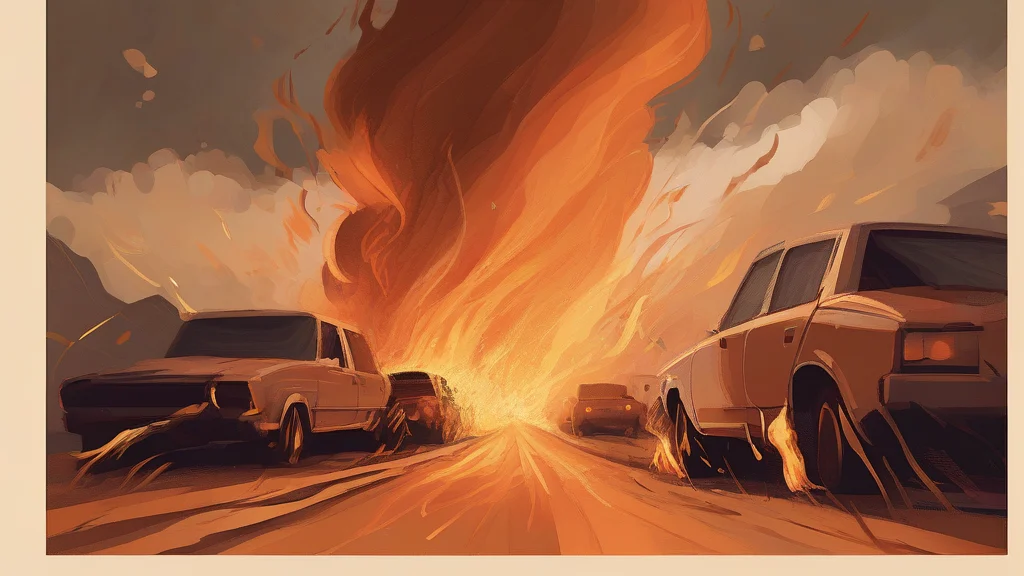
What does deflagration mean?
Deflagration is the technical term for rapid, intense combustion in which a flame front spreads through a combustible material at a speed below that of sound. This distinguishes it from detonation, where the reaction front outruns sound waves and generates a destructive supersonic shock. Deflagrations are characteristic of gunpowder, pyrotechnics, and many accidental explosions involving fuels, gases, or fine dusts suspended in air; they release heat and pressure violently even without a true blast wave. Fire-safety engineers pay close attention to conditions under which a deflagration can accelerate into a detonation. The word comes from Latin deflagrare, 'to burn down', and carries a precise, formal register: it belongs to laboratory reports and engineering literature rather than everyday conversation. Its figurative use for any sudden fiery outburst exists but is uncommon.
nounA rapid, vigorous burning in which a substance combusts intensely but the reaction front travels through it at a speed slower than that of sound in the material — as distinct from an explosion or detonation.
- (Chemistry, physics) Rapid combustion in which the reaction front propagates through the fuel at subsonic speed, generating intense heat and light without a supersonic shock wave.
- (Figurative, rare) A sudden, violent outburst or flare-up.
"The deflagration of the gunpowder produced a bright flash and a rush of hot gas rather than a shock wave."
"The grain silo explosion was classified as a deflagration caused by airborne dust igniting all at once."
"The debate ended in a deflagration of tempers that no moderator could contain."
Standard plural; used both for multiple events and, in engineering contexts, for different types or cases of deflagration.
"Investigators compared several historical dust deflagrations before drafting the new safety code."
Not every explosion is a detonation — most industrial dust explosions are technically deflagrations, with flames racing through the cloud just below the speed of sound.
Reviewed by Deb Chak, Editor. AI-assisted content curated by RJS Tech Solutions LLP.
Etymology of deflagration
Deflagration derives from the Latin verb deflagrare, meaning 'to burn down or burn away', formed from the prefix de- plus flagrare, 'to blaze'. It entered English in the early modern period alongside other terms of alchemy and early chemistry, when scholars sought precise vocabulary for different kinds of burning. It shares its root flagrare with related English borrowings such as conflagration and flagrant.
Related word forms
How deflagration is actually used
A technical term used mainly in chemistry, physics, fire engineering, and explosives science; outside those fields it sounds formal and scientific, so it should not be used casually for any ordinary fire. The figurative sense is rare and literary.
Easily confused with deflagration
A detonation's reaction front travels faster than sound, producing a damaging supersonic shock wave, whereas a deflagration burns rapidly but subsonically.