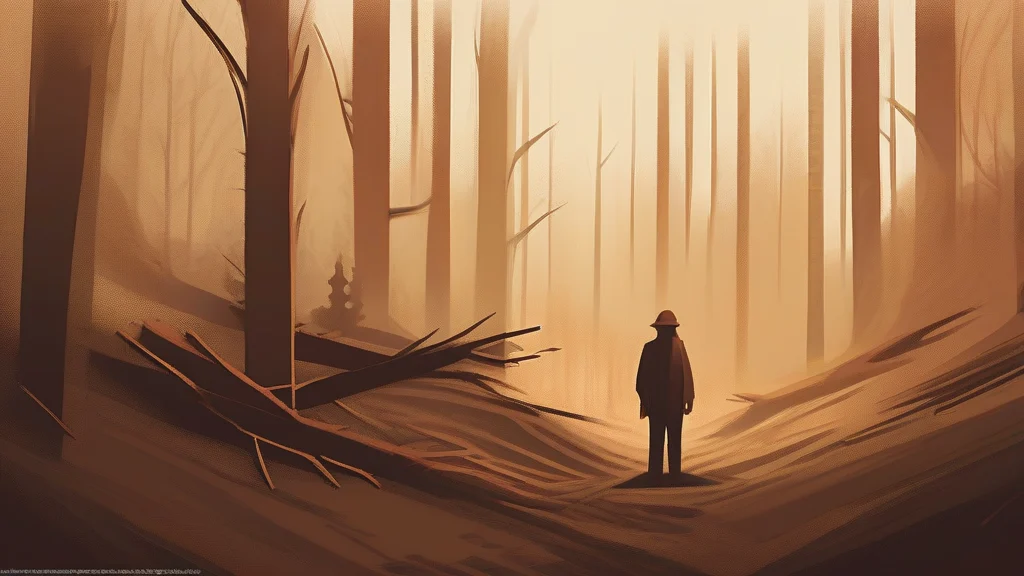
What does deforest mean?
Deforest is a transitive verb meaning to clear an area of land of its trees, typically on a large scale for agriculture, timber harvesting, mining, or urban development. It is most often encountered in environmental science, policy discussions, and journalism about rainforests and other wooded regions, where phrases such as 'heavily deforested' or 'deforested land' are common. The word carries strongly negative connotations, implying not merely tree removal but environmental damage — habitat loss, soil erosion, and contribution to climate change. In practice, the related noun 'deforestation' is more frequently used than the verb itself, though both belong to the same register: serious, factual, and often urgent. The verb can be applied literally to physical clearance or figuratively to describe stripping away something once abundant. Understanding 'deforest' is useful because it anchors one of the central vocabularies of modern ecological debate, pairing naturally with its constructive opposite, 'reforest'.
verbTo clear of forest; to cut down or destroy the trees covering a large area of land, typically for agriculture, logging, or development.
- To clear an area of land of its trees or forest, especially on a large scale.
"Vast tracts of the Amazon continue to be deforested to make way for cattle ranching."
"Logging companies deforested thousands of hectares in a single decade."
"The region was so heavily deforested by the nineteenth century that soil erosion became a serious problem."
Every year, humans deforest an area of tropical forest roughly the size of a small country — and 'deforest' itself has been warning us about it since the 1600s.
Reviewed by Deb Chak, Editor. AI-assisted content curated by RJS Tech Solutions LLP.
Etymology of deforest
The verb deforest was formed in English from the prefix de- (indicating removal) combined with 'forest', a word borrowed into Middle English from Old French, which ultimately derived from Latin 'foris' meaning 'outside' — a forest being originally woodland outside settled areas. The verb is attested from at least the early seventeenth century. Its derivatives include 'deforestation', which became prominent with the rise of modern environmental science, while cognates sharing the same root include 'forestry', 'forester', and the Latinate 'sylvan' family of words relating to woods.
Related word forms
How deforest is actually used
Deforest is a formal or technical verb used mainly in environmental, scientific, and journalistic contexts. It usually appears in the passive ('was deforested') when describing completed land clearance. The noun 'deforestation' is considerably more frequent than the verb itself in everyday usage.
Easily confused with deforest
'Disforest' is an obsolete synonym now rarely used, while 'deforest' is the standard modern term for clearing land of trees.