What does delf mean?
Delf is an English noun with two related but distinct senses. In its older and primary use, chiefly found in British dialect, a delf is a ditch, trench, or drainage channel cut into the earth — the kind of excavation made to drain wet farmland or mark a boundary. The word derives from the same root as the verb 'delve', both tracing back to Old English 'delfan', meaning to dig. By extension, 'delf' also came to serve as an informal shortening of 'delft', referring to the tin-glazed earthenware pottery — often decorated in distinctive blue and white — originally produced in the Dutch city of Delft. Both uses are now largely historical or regional: you are most likely to encounter the word in rural descriptions, local history writing about drainage works, or discussions of antique ceramics. Its rarity gives it a certain charm for writers seeking an evocative, earthy term for a simple dug channel.
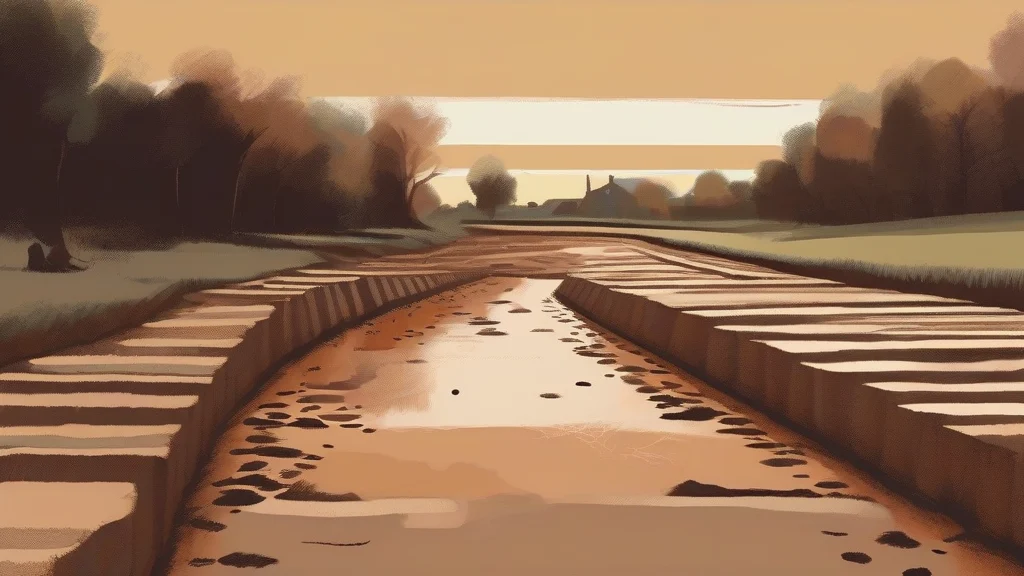
A ditch, trench, or drainage channel dug in the ground.
"Water trickled along the old delf at the edge of the meadow."
Chiefly British dialect; now rare outside regional and historical contexts.
Informally, a shortening of 'delft': tin-glazed earthenware pottery, especially blue-and-white ware.
"The dresser was crowded with delf brought back from Amsterdam."
Casual or trade usage; 'delft' or 'delftware' is more standard.
Used when referring to multiple ditches; rarely encountered, as the word itself is uncommon in modern speech.
"The map marked several old delfs crossing the common."
Before it meant pretty blue-and-white plates, 'delf' was the muddy ditch your great-great-grandparents dug to drain the fields.
Reviewed by Deb Chak, Editor. AI-assisted content curated by RJS Tech Solutions LLP.
Etymology of delf
The noun 'delf' comes from Old English 'delfan', meaning to dig, making it a direct sibling of the verb 'delve'; both descend from Proto-Germanic roots connected to digging. The ditch sense arose as a noun formed from this verb, recorded in English from the medieval period onward and surviving longest in northern and midland British dialects. Separately, 'delf' emerged as a clipped form of 'delft', the English name for the Dutch city Delft and the famous blue-and-white pottery made there from the seventeenth century.
Related word forms
How delf is actually used
Both senses are now rare and somewhat archaic; the ditch sense survives mainly in British regional dialect, and the pottery sense is a casual shortening of 'delft'. The plural 'delfs' is uncommon but attested for multiple ditches.
Easily confused with delf
'Delve' is a verb meaning to dig or search deeply, while 'delf' is a noun denoting a ditch or, informally, delftware pottery.
'Delft' properly names the Dutch city and the blue-and-white pottery associated with it, whereas 'delf' is primarily a dialect word for a ditch or trench.