
What does demantoid mean?
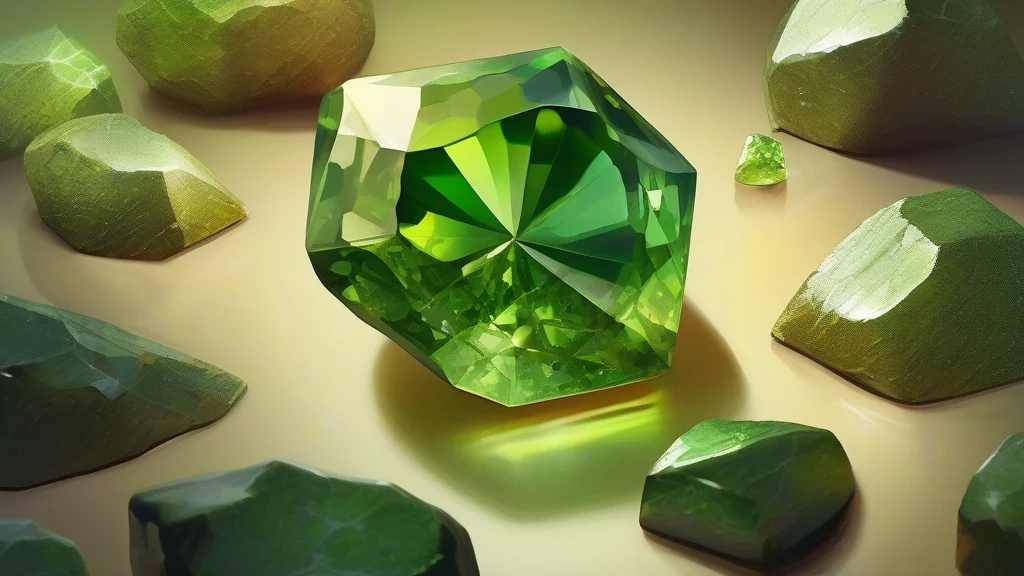
Demantoid is a rare and highly prized gemstone: a vivid green variety of the mineral andradite, which belongs to the garnet family. What sets demantoid apart from other green gems is its remarkable dispersion — the optical property that splits light into spectral flashes — giving cut stones a fiery brilliance often compared to that of diamond. Indeed, the name derives from the old word "demant," meaning diamond, reflecting this dazzling quality. The gem was first identified in Russia's Ural Mountains in the late 1860s and soon became a favorite of the imperial court and of Fabergé's workshops, appearing widely in Edwardian and Art Nouveau jewelry. Fine specimens show a rich grass-green color, sometimes attributed to chromium. Today demantoid remains one of the most valuable garnets, sought by collectors and set chiefly in fine and antique jewelry.
nounA rare, vivid green variety of the mineral andradite garnet, prized as a gemstone; it is distinguished by its high dispersion, which gives it an exceptional brilliance comparable to that of diamond.
- A gem-quality, vivid green variety of andradite garnet, valued for its exceptional brilliance and dispersion.
"The antique brooch was set with a flawless demantoid whose fiery green brilliance outshone every other stone on the tray."
"Jewelers prize demantoid for a dispersion so high that the finished gem flashes with diamond-like fire."
"A strand of Victorian demantoid beads fetched a remarkable price at auction."
Used when referring to multiple stones or specimens, most often in gemological or auction contexts.
"The collection included several fine demantoids from the Ural deposits."
Discovered in Russia's Ural Mountains in 1868, demantoid was so brilliantly fiery that it was named after the diamond — and it quickly became the favorite gemstone of the Russian imperial court.
Reviewed by Deb Chak, Editor. AI-assisted content curated by RJS Tech Solutions LLP.
Etymology of demantoid
The word "demantoid" combines "demant," an older term for diamond borrowed from French "diamant" (ultimately from Greek "adamas," meaning unconquerable or invincible), with the suffix "-oid," meaning "resembling." It thus literally means "diamond-like," a reference to the stone's extraordinary luster and fire. The term was coined in the late nineteenth century after the gem's discovery in the Ural Mountains around 1868. Its root also underlies English words such as "diamond," "adamant," and "adamantine."
How demantoid is actually used
"Demantoid" is a technical term used mainly in gemology, mineralogy, jewelry trade contexts, and discussions of antique jewelry. It is almost always encountered in the phrase "demantoid garnet." It carries connotations of rarity, luxury, and collector value rather than everyday use.
Easily confused with demantoid
Emerald is a green variety of the mineral beryl, whereas demantoid is a green garnet of the andradite family; demantoids typically have more fire (dispersion) and are often more yellowish-green.