What does demoiselle mean?
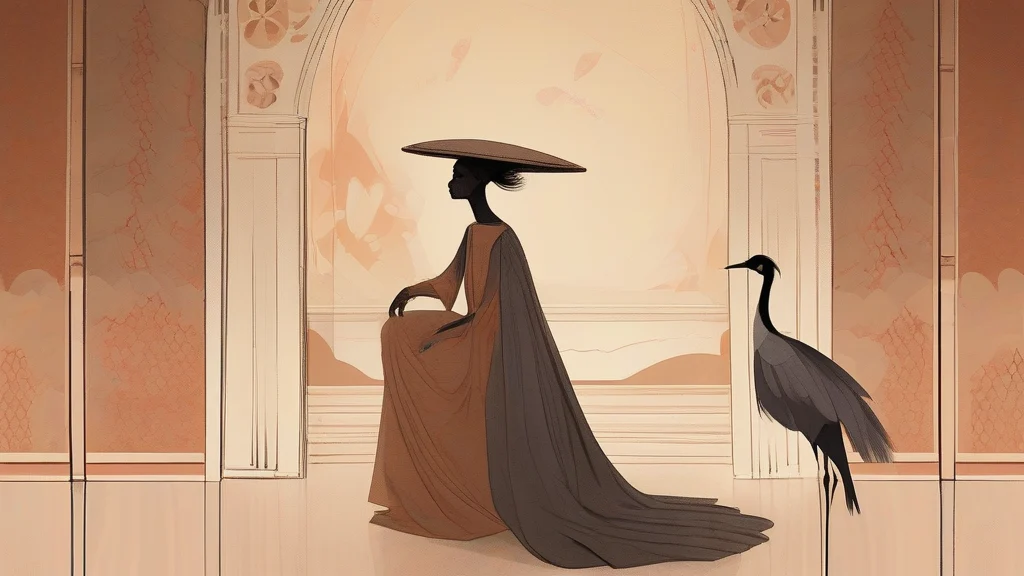
Demoiselle is a noun with two lives. In its older, human sense it denotes a young lady — a girl or unmarried woman of genteel standing — a usage inherited from French that survives today mostly in literature and historical writing, where it lends an air of courtly elegance. Its second life is in natural history, where the word's suggestion of delicacy made it a fitting name for graceful animals: the demoiselle crane, a small, slender crane of Eurasia and Africa famed for its balletic courtship dances, and the demoiselle damselflies, whose males shimmer in metallic blue or green above European streams. The word entered English from Old French demoisele, itself a diminutive of dame, ultimately from Latin domina, 'mistress' or 'lady' — making it a close cousin of damsel and mademoiselle. Whether describing a maiden or a mayfly-like insect, demoiselle consistently evokes grace, youth, and refinement.
A young lady; a girl or young unmarried woman, especially one of gentle birth (now chiefly literary or archaic).
"The ballroom was filled with demoiselles awaiting their first dance."
Largely superseded in everyday speech by 'girl' or 'young lady'; retained in historical fiction and translations of medieval romance.
A demoiselle crane, a small, elegant crane native to Eurasia and Africa, known for its elaborate courtship displays.
"Thousands of demoiselles gather each autumn at their migratory stopovers."
Any of several large, brightly colored damselflies, such as the banded demoiselle or beautiful demoiselle.
"A male banded demoiselle hovered over the water, its dark wing-patch catching the light."
Standard plural; used for all senses of the word.
"The wetlands reserve protects a breeding colony of demoiselles."
"Mademoiselle" is just "my demoiselle" in disguise — both trace back to Latin domina, meaning lady of the house.
Reviewed by Deb Chak, Editor. AI-assisted content curated by RJS Tech Solutions LLP.
Etymology of demoiselle
Demoiselle comes from Old French demoisele, a diminutive formed on dame ('lady'), which descends from Latin domina, 'mistress of the household.' It was borrowed into English in the late Middle Ages, initially as a title for a young unmarried woman of noble birth, parallel to damsel, which arrived through the same lineage. The word was later extended to the demoiselle crane and to certain showy damselflies because of their delicate, elegant appearance. Cognates include mademoiselle and damsel, all rooted in the same Latin word for a female head of household.
How demoiselle is actually used
In its sense of 'young lady,' demoiselle is now largely literary, historical, or deliberately archaic, carrying a refined, old-world connotation. The ornithological and entomological senses remain current in natural-history writing.
Easily confused with demoiselle
A damselfly is any insect of the suborder Zygoptera, while a demoiselle specifically refers to the larger, more brilliantly colored damselflies such as the banded demoiselle.