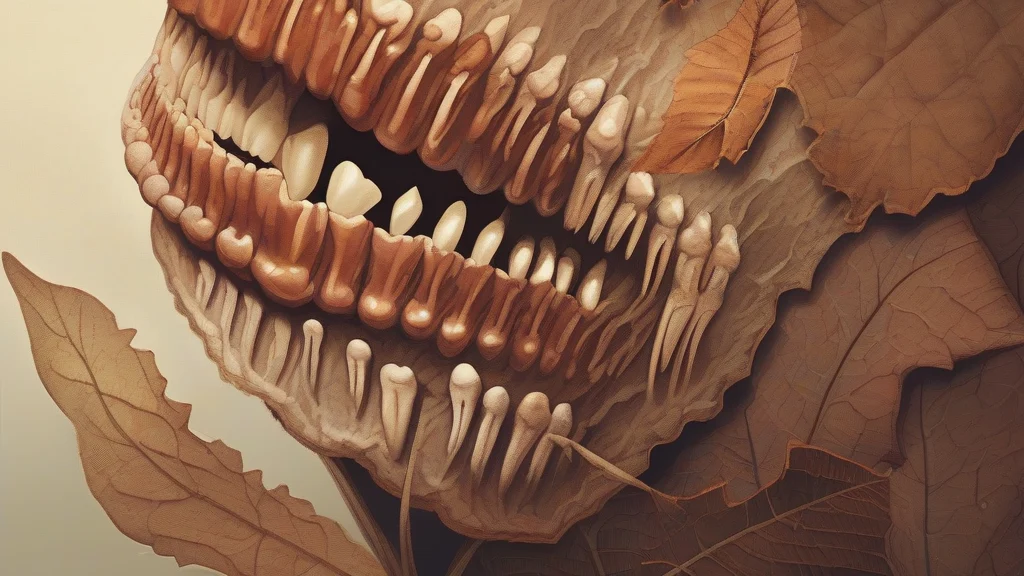
What does dentate mean?
Dentate is an adjective meaning toothed or bearing tooth-like projections. It is chiefly a scientific term: botanists use it to describe leaves whose edges are lined with outward-pointing, right-angled teeth, while anatomists apply it to structures with tooth-shaped ridges, most famously the dentate nucleus of the cerebellum and the dentate gyrus of the hippocampus. The word comes from the Latin dens, meaning tooth — the same root behind dentist, dental, and trident — so its meaning is easy to anchor once that connection is made. Because it belongs largely to technical registers, dentate rarely appears in casual conversation, but it is indispensable in descriptive botany and neuroanatomy, where precise distinctions between edge shapes matter. Related terms such as bidentate (having two teeth) extend its usefulness in chemistry and biology.
adjectiveHaving a toothed or notched edge or margin, as in a leaf with serrated teeth. In anatomy and zoology, having tooth-like projections or structures.
- (Botany) Having a margin edged with outward-pointing tooth-like projections, as in certain leaves.
- (Anatomy, Zoology) Having tooth-like projections, parts, or structures.
"The dentate margins of the oak leaf distinguish it from the smooth-edged beech."
"Botanists classified the specimen by its distinctly dentate leaf margins."
"The dentate gyrus of the hippocampus plays a key role in forming new memories."
The same Latin root that gives us 'dentist' also describes the jagged edges of leaves — and the dentate nucleus of your brain is literally named for its tooth-like wrinkled shape.
Reviewed by Deb Chak, Editor. AI-assisted content curated by RJS Tech Solutions LLP.
Etymology of dentate
Dentate derives from the Latin dens (stem dent-), meaning 'tooth,' via the past-participial stem of densare or directly from dentatus, 'toothed.' It entered English in the early modern period through scientific Latin, where it was adopted into botanical and anatomical nomenclature. It shares this root with a broad family of words including dental, dentist, denture, trident, and indent, all tracing back to the same Indo-European root for tooth (*h₁dont-), which also yields English 'tooth' itself through Germanic rather than Latinate inheritance.
Related word forms
How dentate is actually used
Primarily a technical term used in botany, anatomy, and zoology rather than everyday speech. In botany, it is distinguished from related terms such as 'serrate' (forward-pointing teeth) and 'crenate' (rounded scalloped teeth).
Easily confused with dentate
Edentate means toothless (as in the order Edentata including anteaters), the opposite of dentate.
Serrate describes teeth pointing forward like a saw blade, while dentate describes outward-pointing teeth at right angles to the margin.