What does dentin mean?
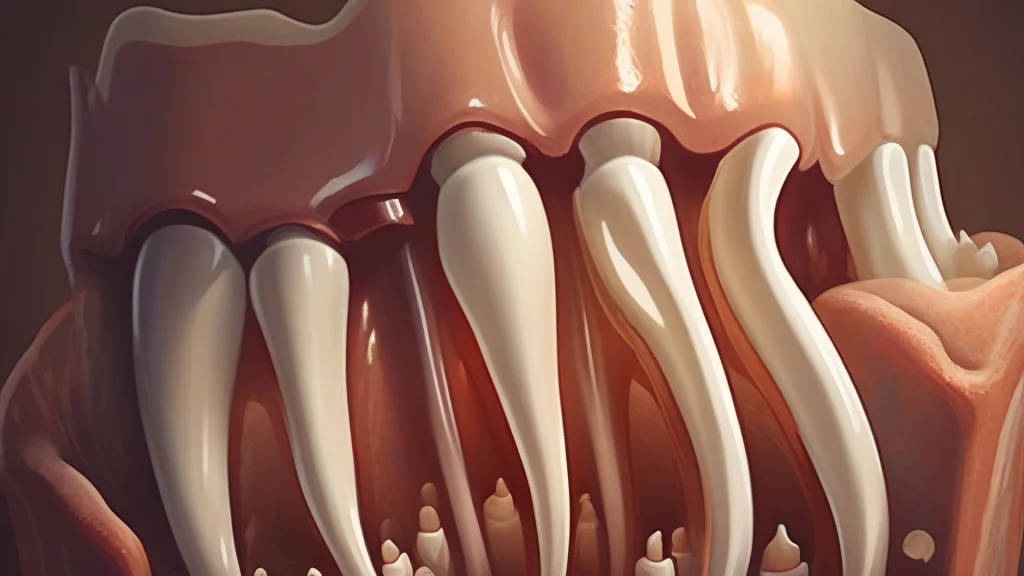
Dentin is the hard, bone-like tissue that forms the bulk of every tooth, sitting just beneath the enamel of the crown and the cementum of the root and enclosing the soft pulp at the tooth's core. Slightly softer than enamel but far tougher than bone, it is riddled with microscopic tubules that run toward the nerve, which is why decay or wear reaching the dentin often triggers sudden sensitivity to heat, cold, or sweets. Unlike enamel, dentin continues to be produced throughout life, so teeth gradually accumulate layers of secondary dentin with age. The term belongs chiefly to the vocabulary of dentistry, anatomy, and paleontology, where researchers even study fossilized dentin to learn how extinct animals lived. Its everyday relevance lies mainly in tooth sensitivity and dental care, making it a useful word for anyone reading about oral health.
nounThe dense, bony tissue that forms the bulk of a tooth beneath the enamel and cementum, surrounding the pulp chamber.
- The calcified tissue making up the main body of a tooth, lying beneath the enamel in the crown and beneath the cementum in the root, surrounding the pulp.
"When the enamel wears away, the exposed dentin makes the tooth sensitive to hot and cold."
"A cavity that reaches the dentin typically causes sharp pain because the tissue contains tiny tubules connected to the nerve."
"Under the microscope, secondary dentin laid down over the years can be seen narrowing the pulp chamber of an older tooth."
Rarely used; dentin is normally an uncountable noun referring to the tissue type generally. A plural appears only when contrasting samples from different teeth or species.
"Researchers compared the mineral density of dentins taken from molars and incisors."
That yellow tinge in aging teeth isn't staining at all — it's the dentin showing through as translucent enamel thins.
Reviewed by Deb Chak, Editor. AI-assisted content curated by RJS Tech Solutions LLP.
Etymology of dentin
Dentin derives from the Latin noun "dens" (stem "dent-"), meaning tooth, combined with the suffix "-in," used in chemistry and anatomy to denote a substance. The word was coined in the nineteenth century, during the period when anatomical nomenclature was being standardized on classical roots, and the variant spelling "dentine" appeared around the same time. It shares its Latin root with a wide family of English words including dentist, dental, denture, trident, indent, and even dandelion, which comes from the French "dent de lion," or lion's tooth.
How dentin is actually used
Primarily used in dentistry, anatomy, and paleontology; the spelling "dentine" (with a final e) is an equally accepted variant, especially common in British usage. The word is uncountable in most contexts, though "dentins" occasionally appears when comparing tissue across different teeth or species.
Easily confused with dentin
Dentition refers to the arrangement, type, and number of an animal's teeth as a whole, whereas dentin is the hard tissue forming the body of each individual tooth.
Enamel is the hard outer covering of the tooth crown that sits on top of and protects the underlying dentin.