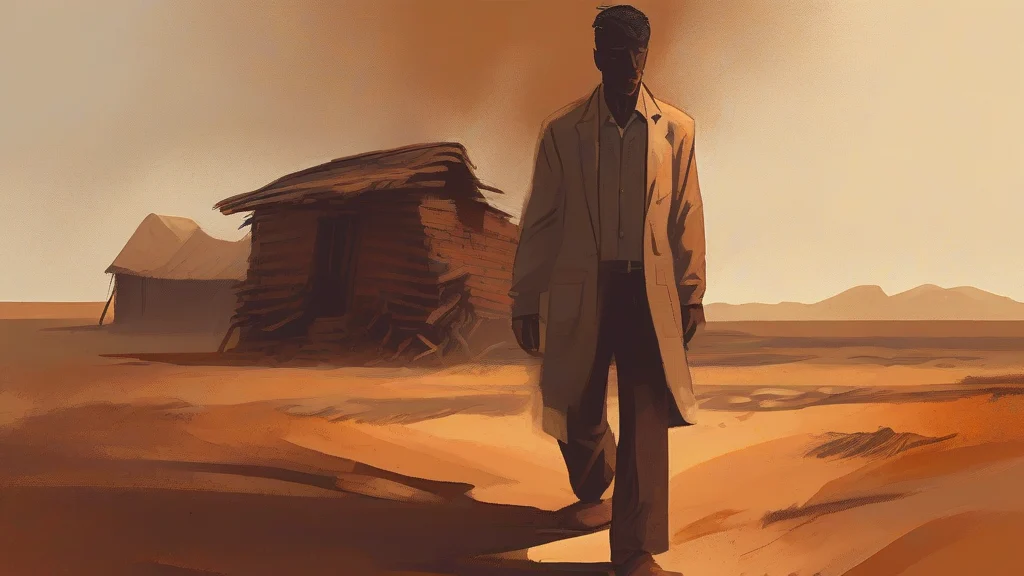
What does deracinate mean?
To deracinate is to pull something up by its roots, whether literally, as when a storm tears a tree from the ground, or figuratively, as when war, migration, or social upheaval tears people from the land, language, and traditions that shaped them. The verb derives from French déraciner, built on the Latin radix meaning 'root,' making it a close cousin of eradicate, radical, and even radish. In modern usage deracinate appears most often in literary, historical, and sociological writing about displaced peoples — exiles, refugees, diasporic communities — where it connotes not just movement but a wrenching severance from one's origins. It is a formal, somewhat elevated word that lends gravity to discussions of identity and belonging, offering writers a precise alternative to the more everyday 'uproot' when the emphasis falls on the loss of rootedness itself.
verbTo uproot or tear something away from its native soil or environment; figuratively, to displace a person from their cultural roots, homeland, or accustomed way of life.
- (of a plant) to uproot or remove from the soil.
- (of a person or community) to displace from one's native land, culture, or established social environment.
"The war deracinated entire communities, scattering families across three continents."
"The hurricane deracinated centuries-old oaks along the boulevard."
"Immigrant writers often write about feeling deracinated, caught between two cultures."
Deracinate literally means to rip something out 'from the roots' — the same Latin word for root that gives us radishes and radicals.
Reviewed by Deb Chak, Editor. AI-assisted content curated by RJS Tech Solutions LLP.
Etymology of deracinate
Deracinate comes from French déraciner ('to uproot'), formed from the prefix dé- plus racine ('root'), which traces back through Old French to Latin radix, meaning 'root.' The word entered English in the early 17th century. Its Latin lineage makes it a sibling of eradicate ('to pull out by the roots'), radical ('of the root'), and radish — all ultimately descendants of radix.
Related word forms
How deracinate is actually used
Formal and somewhat literary in register. When applied to people, it often carries a note of loss or alienation rather than mere relocation. More common in British English than American English, where 'uproot' tends to be preferred in everyday use.
Easily confused with deracinate
Eradicate means to destroy or eliminate something completely, while deracinate means to pull it out of its native soil or cultural context — eradication destroys, deracination displaces.