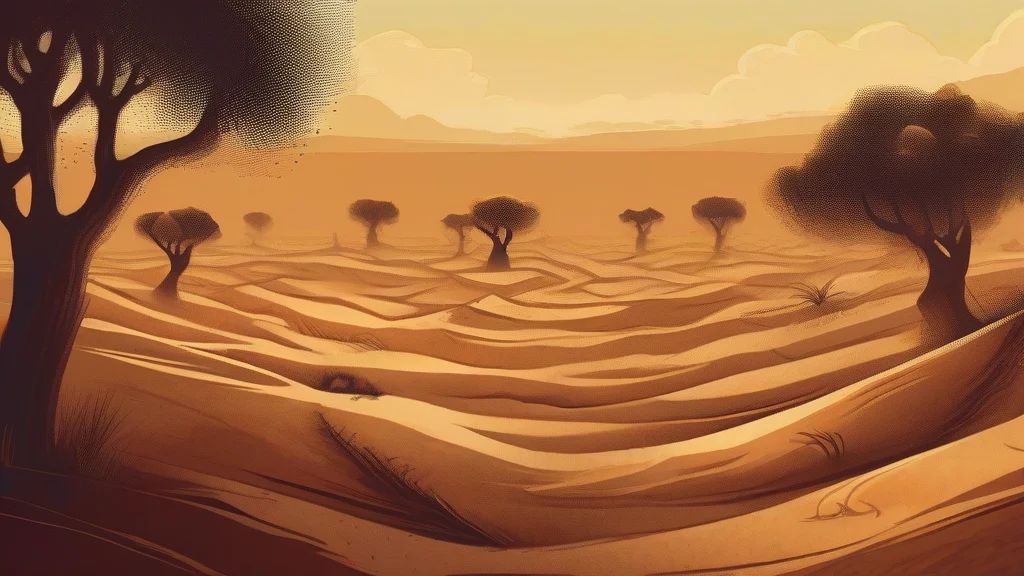
What does desertification mean?
Desertification is the process by which fertile land gradually loses its productivity and becomes more like a desert. It occurs mainly in dry regions — arid, semi-arid, and dry sub-humid areas — where drought, climate change, deforestation, overgrazing, and poor irrigation combine to strip the soil of its vegetation and nutrients. Although natural forces play a role, the term usually implies that human activity has made things worse, which gives the word a distinctly negative, cautionary tone. Desertification features prominently in environmental science, geography, journalism, and international policy: the United Nations Convention to Combat Desertification, adopted in 1994, reflects how seriously the problem is taken globally, since it threatens food security and displaces millions of people. The word entered common use after the severe Sahel droughts of the 1970s. Despite appearances, it is not simply 'making deserts' — it describes the degradation of already productive land, making it a precise and important term for discussing environmental decline.
nounThe process by which fertile land becomes desert, typically as a result of drought, deforestation, or inappropriate agriculture. It refers to the degradation of land in arid, semi-arid, and dry sub-humid areas.
- The process by which fertile or habitable land becomes increasingly arid and eventually turns into desert, especially through climatic change or destructive human activity such as overgrazing, deforestation, and poor irrigation.
"Overgrazing and poor irrigation practices have accelerated desertification across the Sahel."
"Rising temperatures and unsustainable farming have led to widespread desertification in the region."
"The United Nations has designated June 17 as the World Day to Combat Desertification."
The word 'desertification' was popularised after a devastating drought in the African Sahel in the 1970s — and today it threatens the livelihoods of over a billion people worldwide.
Reviewed by Deb Chak, Editor. AI-assisted content curated by RJS Tech Solutions LLP.
Etymology of desertification
Desertification derives from the noun 'desert', which comes via Old French from Late Latin 'desertum', meaning an abandoned or uninhabited place — itself from the past participle of Latin 'deserere', 'to abandon or forsake' (from 'de-' meaning away plus 'serere', to join). The suffix '-fication', from Latin '-ficare', indicates the act of making or producing something. The English formation follows the pattern of other '-ification' nouns such as justification, and the term gained currency in the mid-20th century, becoming widespread following the Sahel droughts of the 1960s and 1970s.
How desertification is actually used
A formal, technical term used mainly in environmental science, geography, policy, and news reporting. It carries strongly negative connotations, implying environmental damage and often human mismanagement. Note that despite its spelling, the first syllable is pronounced like 'dessert', not 'desert'.
Easily confused with desertification
Deforestation is the removal of forests specifically, while desertification is the broader process by which any fertile land turns into desert.