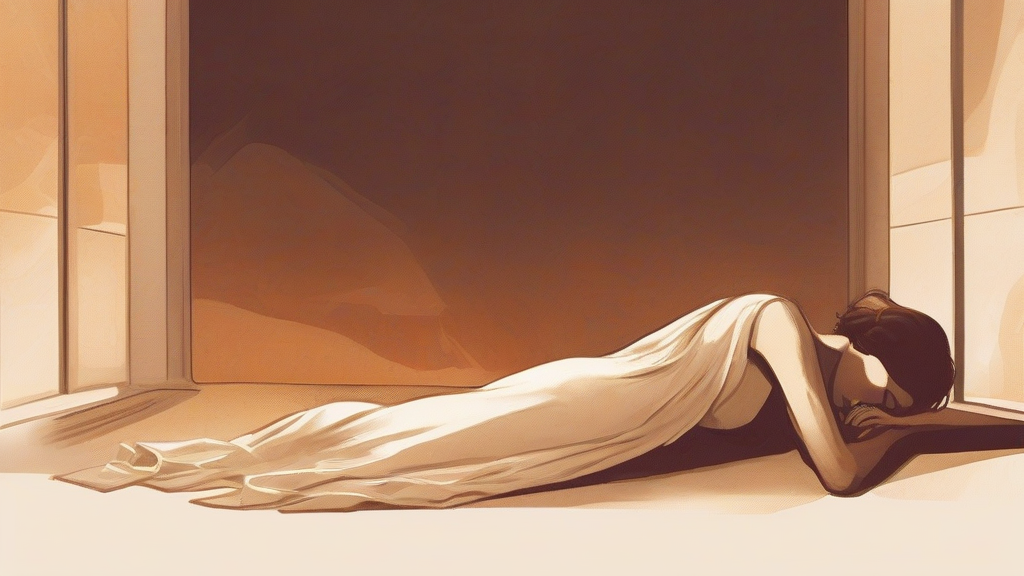
What does deshabille mean?
Deshabille refers to the state of being partially, casually, or carelessly dressed — the loose, informal condition of someone who has not yet donned full attire. Borrowed from French in the early seventeenth century, it derives from déshabiller, meaning 'to undress.' In modern English the word is distinctly literary and somewhat rare, prized for the elegance it lends to descriptions of private or unguarded moments. Crucially, its connotation is usually favorable or playful: to be caught in 'elegant deshabille' suggests a graceful, even alluring informality rather than mere sloppiness, though the word can occasionally imply genuine disarray. Writers use it for figures lounging at home, receiving unexpected guests, or portrayed by painters who wished to capture relaxed intimacy. The variant spelling 'dishabille' is common, especially in American English, but both forms carry identical meaning and history.
nounThe state of being partly or carelessly dressed; informal or disheveled attire, especially as worn in private or upon first rising.
- The state of being only partly or casually dressed; informal attire, especially in private or just after rising.
- Carelessly or slovenly arranged clothing; a disheveled appearance (less common).
"She answered the door in elegant deshabille, her robe loosely tied and hair still unbrushed."
"He lounged about the house in comfortable deshabille, unwilling to face the formality of a pressed shirt before noon."
"The duchess received her closest confidante in artful deshabille, a calculated informality that signaled intimacy rather than neglect."
Rarely pluralized, since deshabille usually denotes a state rather than a countable garment; when it refers to items of clothing, either the plural 'deshabilles' or the invariant form may be seen.
"Her various deshabilles were scattered across the chaise longue."
This word literally means 'undressed' — so when a portrait painter praised a sitter's 'elegant deshabille,' they were flattering someone for being caught half-dressed.
Reviewed by Deb Chak, Editor. AI-assisted content curated by RJS Tech Solutions LLP.
Etymology of deshabille
Deshabille entered English from French in the early seventeenth century, derived from the French verb déshabiller, meaning 'to undress,' which combines the prefix dé- ('un-') with habiller ('to dress'). Habiller itself traces back through Old French to the Germanic root behind 'habit' and 'habiliments.' The anglicized spelling 'dishabille' arose later and remains an accepted variant, particularly in American usage.
How deshabille is actually used
Deshabille is a literary and somewhat formal word, often carrying a playful, romantic, or deliberately artistic connotation rather than a negative one. It typically implies charming informality rather than genuine slovenliness, though it can occasionally suggest untidiness. The spelling 'dishabille' is an established variant, more frequent in American usage.
Easily confused with deshabille
Dishabille is merely an anglicized spelling variant of the same word — the two spellings refer to exactly the same meaning, with 'dishabille' now more common in American English.