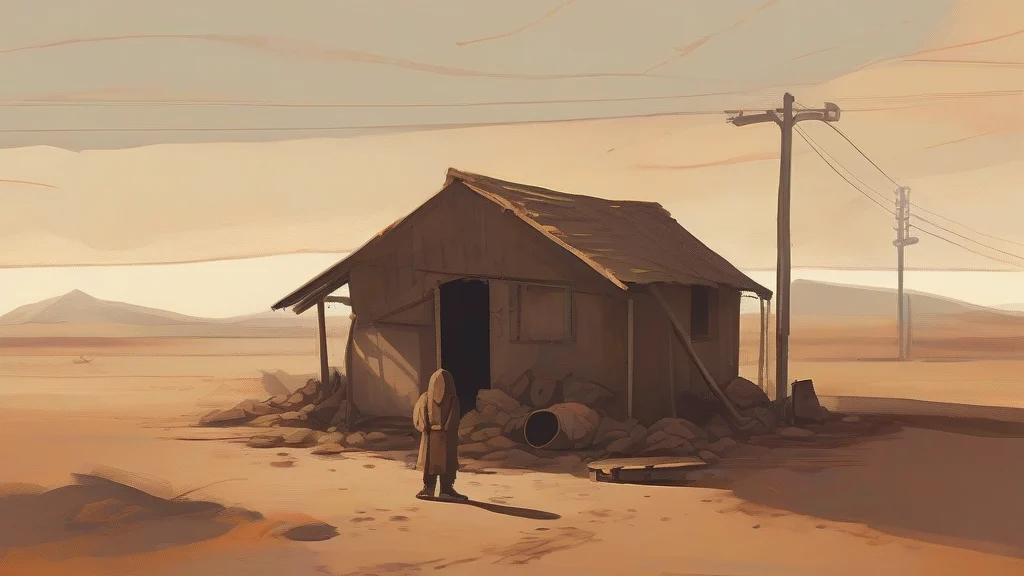
What does destitution mean?
Destitution is a noun describing the condition of extreme poverty in which a person lacks the fundamental necessities of life — food, shelter, clothing, and other means of survival. It is a stronger term than mere poverty: someone living in destitution has been stripped of subsistence itself, which is why the word appears so often in humanitarian reports, legal contexts concerning asylum seekers and welfare, and historical accounts of famine or economic collapse. The word carries a serious, formal register and is rarely used casually. It derives from Latin destituere, meaning to abandon or forsake, so at its root it evokes the idea of being left with nothing. Beyond its literal sense, destitution can describe an utter lack of any abstract quality, as in "a destitution of compassion," though this figurative use is comparatively rare. Common pairings include "utter destitution," "reduced to destitution," and "faced with destitution."
Extreme poverty; the state of lacking the basic necessities of life.
"The charity provides emergency aid to families facing absolute destitution."
Often intensified by adjectives such as "utter," "absolute," or "complete," since the noun alone denotes an already extreme condition.
A complete lack or absence of something (usually followed by "of").
"He spoke with a destitution of warmth that unsettled everyone present."
This figurative sense is less common than the literal one.
Rarely used in the plural, as the noun normally functions as an uncountable mass noun referring to a general condition. A plural form occasionally appears in literary or older usage to denote multiple instances or kinds of deprivation.
"The memoir recounts the many destitution she endured in her youth."
"Destitution" comes from the Latin for "to stand apart or abandon" — to be destitute was originally to be forsaken, left standing alone with nothing.
Reviewed by Deb Chak, Editor. AI-assisted content curated by RJS Tech Solutions LLP.
Etymology of destitution
Destitution comes from the Latin destitutio, meaning abandonment or deprivation, formed from the verb destituere — literally "to set aside, leave standing, abandon" — from de- (away from) plus statuere (to set up, place). The word entered English in the late Middle English period via Old French, initially carrying senses of forsaking or desertion before settling on its dominant modern sense of extreme poverty. It shares its Latin root statuere with a family of words including constitute, institute, substitute, and restitution.
How destitution is actually used
"Destitution" is a formal word, more severe than "poverty": it implies not just low income but the actual lack of life's essentials. It is most often used in social, legal, and humanitarian contexts, frequently appearing in phrases like "destitute of" when used figuratively.
Easily confused with destitution
Prostitution refers to the practice of engaging in sexual activity in exchange for payment, whereas destitution means extreme poverty; the two words share a similar shape but nothing else.