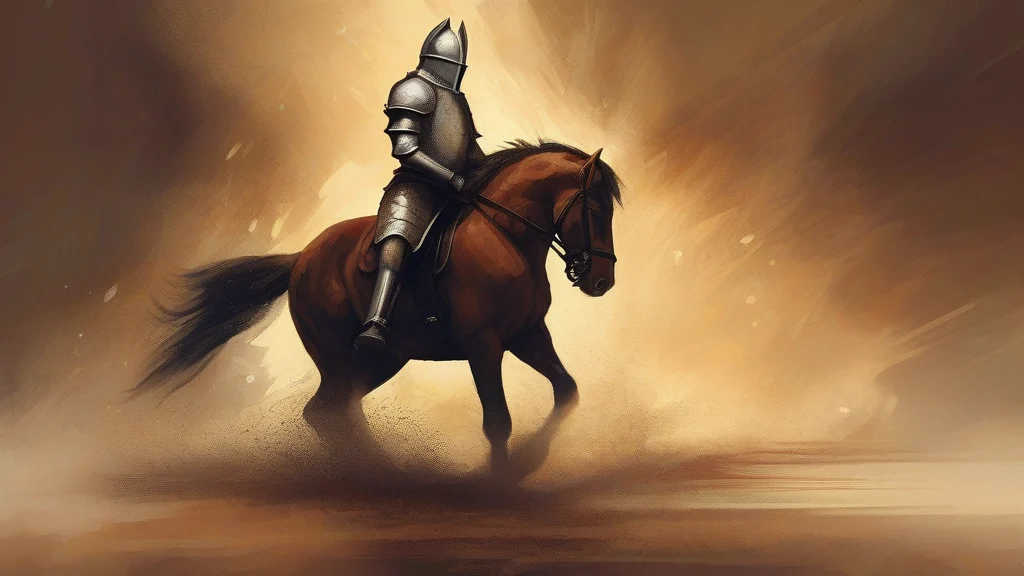
What does destrier mean?
A destrier was the great warhorse on which a medieval knight rode into combat or took his place in the tournament lists. Larger, stronger, and far more expensive than ordinary horses, it was trained to bear the combined weight of an armored rider and heavy tack, and to remain steady amid the chaos of a charge. Within a knight's household the destrier ranked at the top of a hierarchy that also included lighter coursers for hunting and smooth-gaited palfreys for travel. Because such animals were costly to breed, feed, and maintain, owning one was itself a marker of wealth and status, and the word has come to evoke the whole pageantry of chivalry. Today destrier survives almost entirely in historical and literary contexts, lending an appropriately archaic flavor to writing about knights, jousts, and medieval battle.
nounA powerful warhorse ridden by a knight in battle or in the tournament lists; the largest and most valuable horse in a medieval knight's retinue.
- A large, strong horse trained for carrying a knight in battle or tournaments
"The knight's destrier, caparisoned in his lord's colors, pawed the ground before the charge."
"The destrier thundered across the field as the two knights closed for the joust."
"Feeding and stabling a single destrier could cost more than an ordinary laborer earned in a year."
Regular plural; used when referring to multiple warhorses, often in descriptions of armies or households.
"Dozens of destriers were ferried across the Channel for the campaign."
A knight's destrier was so valuable it was worth more than the armor and weapons he rode into battle with — sometimes more than everything else he owned.
Reviewed by Deb Chak, Editor. AI-assisted content curated by RJS Tech Solutions LLP.
Etymology of destrier
Destrier comes from Old French, where it described a knight's warhorse. The traditional explanation derives it from Vulgar Latin *destrarius, meaning a horse 'led by the right hand' (from Latin dexter), supposedly because it was led at a squire's right side when not in use. It is thus related etymologically to words built on dexter, such as dexterous and dexterity.
How destrier is actually used
Destrier is now almost exclusively encountered in historical writing about the Middle Ages — in accounts of chivalry, tournaments, and warfare. It carries a deliberately archaic, elevated register and is rarely if ever used of modern horses. It is more specific than 'warhorse' or 'steed', denoting the knight's principal battle mount rather than any horse ridden to war.
Easily confused with destrier
A palfrey was a smooth-gaited riding horse used for everyday travel by nobles, whereas a destrier was a heavy warhorse reserved for battle.