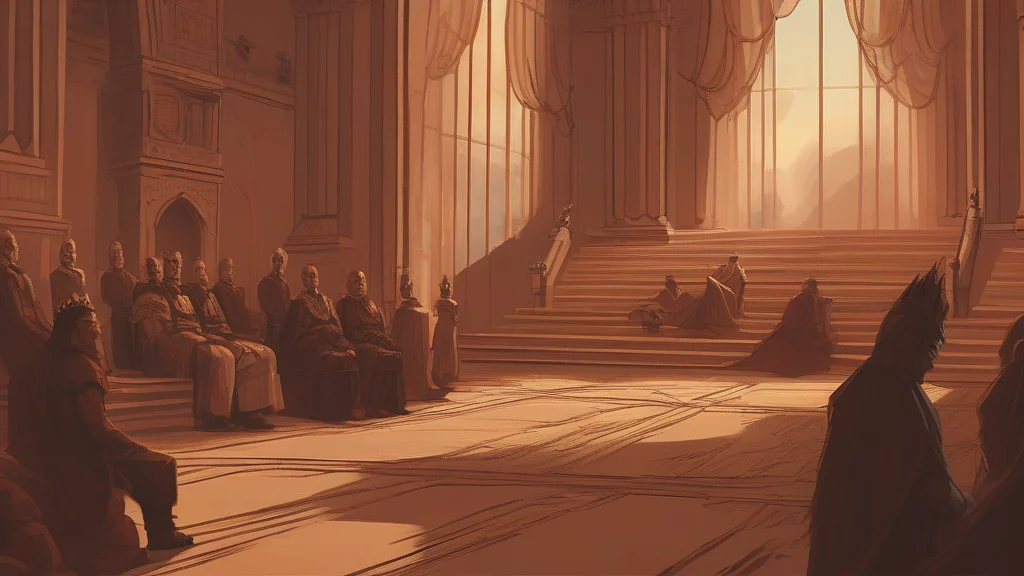
What does dethroned mean?
Dethroned describes someone who has been removed from a throne or from supreme power, most commonly a monarch forced out by rebellion, coup, conquest, or abdication under pressure. The word derives from 'throne,' tracing back through Latin and Greek to the Greek 'thronos,' meaning an elevated seat — originally the very chair symbolizing divine or royal authority. To dethrone someone is therefore literally to take away the seat that embodies their rule. Beyond its literal royal sense, the term has broadened into figurative use: a dethroned champion has lost a title, a dethroned market leader has lost commercial supremacy, and a dethroned idea has been displaced as conventional wisdom. The word carries connotations of fall and displacement, often implying that the person or thing once held unassailable status. It appears frequently in history writing, sports coverage, and business commentary, making it a versatile and vivid alternative to blander terms like removed or defeated.
Past tense and past participle of 'dethrone': removed from a throne or position of sovereign power; deprived of a dominant position.
"Parliament voted, and the king was dethroned within weeks."
Frequently appears in the passive voice ('was dethroned'), reflecting that the removal is usually imposed by external forces.
Having been removed from power or from a leading position; no longer reigning or dominant.
"A dethroned beauty queen spoke candidly about life after her reign."
Every dethroned king was once untouchable — which is why English borrowed this word straight from the Greek word for a seat of the gods.
Reviewed by Deb Chak, Editor. AI-assisted content curated by RJS Tech Solutions LLP.
Etymology of dethroned
Dethroned is the past form of 'dethrone,' formed in English by prefixing the privative 'de-' onto 'throne.' The noun 'throne' entered Middle English from Old French 'trone,' ultimately from Latin 'thronus' and Greek 'thronos,' meaning an elevated seat, particularly one occupied by gods or kings. The verb 'dethrone' arose in English around the early 17th century, during an era rich in royal deposition across Europe, and quickly acquired both its literal sense of removing a monarch and its figurative sense of displacing anyone from preeminence.
Related word forms
How dethroned is actually used
Mostly used in historical, political, and sporting contexts. The literal sense applies to deposed royalty; the figurative sense is common in sports journalism and discussions of markets or institutions that have lost dominance. The adjective form typically appears attributively ('a dethroned queen').
Easily confused with dethroned
'De-thawed' means thawed (defrosted), while 'dethroned' means removed from power — the similar 'de-' prefix does not imply opposite meanings here.