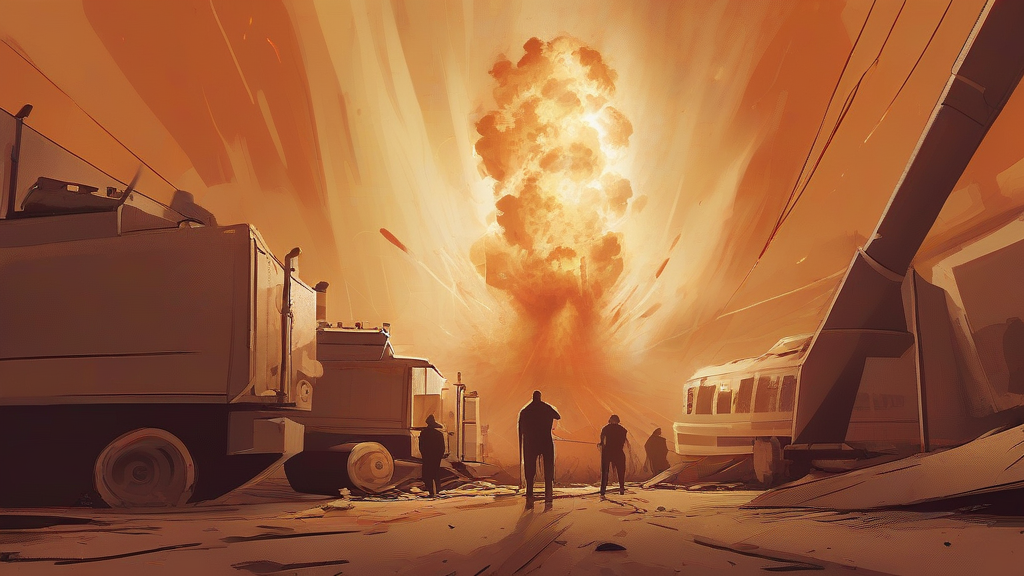
What does detonation mean?
Detonation is a noun referring to the sudden, violent release of energy that occurs when an explosive substance explodes. Unlike slower forms of burning, a true detonation involves a shock wave travelling through the explosive material at supersonic speed, producing a sharp blast rather than a progressive fire. The word is most familiar in military and demolition contexts — a nuclear detonation or the controlled detonation of a building — but it also has an important technical sense: in an internal-combustion engine, detonation describes the spontaneous, uncontrolled ignition of fuel, better known as knocking, which can damage the engine. The term carries connotations of force and precision; engineers speak of 'controlled' detonations when destruction must be deliberate rather than accidental. Derived from Latin roots meaning 'to thunder down', detonation entered English in the seventeenth century and remains the standard word wherever explosive force must be described with accuracy.
The act or process of exploding violently, especially as the result of a rapid chemical reaction in an explosive substance; a blast.
"The detonation shattered windows for blocks around the test site."
In explosives engineering, distinguished from deflagration by the supersonic speed of the reaction front.
Spontaneous, uncontrolled combustion of part of the fuel–air mixture in an internal-combustion engine, typically heard as a metallic knock.
"Using a higher-octane fuel helped eliminate the detonation that had been plaguing the engine."
Also called 'knocking' or 'pinging'; the reason high-octane fuels exist.
Regular plural; commonly used when referring to multiple blasts or repeated instances of engine knock.
"Residents reported hearing several detonations throughout the night."
In an engine, detonation is so violent it can punch holes in pistons — which is why the fuel grade called 'high octane' exists at all.
Reviewed by Deb Chak, Editor. AI-assisted content curated by RJS Tech Solutions LLP.
Etymology of detonation
Detonation derives from the Latin verb detonare, formed from de- ('down') plus tonare ('to thunder'), literally 'to thunder down'. The English noun arose in the early seventeenth century alongside the verb detonate, originally used of gunpowder explosions. Its root tonare also gives English words such as thunder's Latin-derived cousins and, through tonus, terms like tone and intonation — though denotation and notation share only the de-/not- spelling coincidence with detonation, not its thunderous root.
Related word forms
How detonation is actually used
Register is neutral to technical; common in military, mining, demolition, and automotive contexts. In physics, detonation specifically denotes supersonic combustion, contrasted with deflagration (subsonic burning).
Easily confused with detonation
Denotation refers to the literal or primary meaning of a word, while detonation is an explosion.