
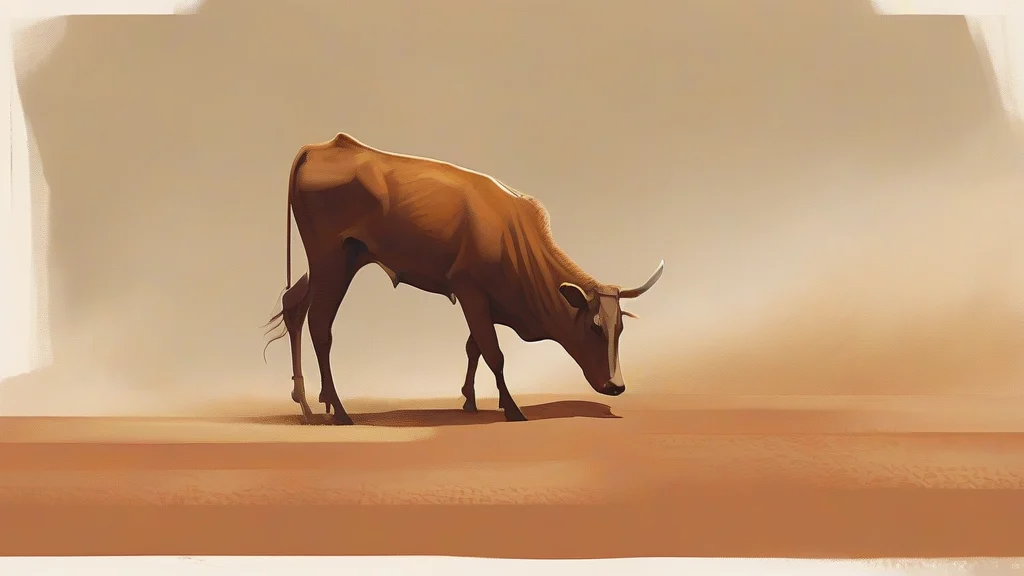
What does dewlap mean?
A dewlap is a loose, often pendulous fold of skin that hangs from the throat or neck of certain animals. The feature is most famously seen in cattle breeds such as the zebu, where the dewlap can be strikingly large, but it also appears in reptiles like iguanas and anoles — where males extend a brightly coloured dewlap to signal territory or attract mates — and in birds such as turkeys and frigatebirds. In everyday English the word belongs mostly to zoology, veterinary medicine, and nature writing, giving descriptions precision that a phrase like 'hanging skin' lacks. Used of people, it takes on a humorous or mildly unflattering tone, evoking loose flesh beneath the chin. Etymologically, 'dew' combines with 'lap', reflecting the old notion that the fold was large enough to gather morning dew. For anyone reading about livestock, herpetology, or animal display behaviour, 'dewlap' is the exact term for this distinctive anatomical feature.
nounA loose fold of hanging skin, especially under the throat or neck of an animal such as a cow, lizard, or turkey.
- A pendulous fold of loose skin on the throat or neck of an animal, as in cattle, lizards, or birds.
"The old bull's dewlap swayed gently as it grazed by the riverbank."
"The green iguana extended its orange dewlap in an impressive display of dominance."
"With age, the zebu developed a remarkably large dewlap that hung well below its jaw."
Standard regular plural, used when referring to multiple animals or to the feature across a species.
"Both bulls had heavy, wrinkled dewlaps."
That floppy fold under an iguana's chin has its own name — and it literally comes from the idea of skin that could catch the morning dew.
Reviewed by Deb Chak, Editor. AI-assisted content curated by RJS Tech Solutions LLP.
Where does dewlap come from?
The word dewlap dates from Middle English, formed from 'dew' plus 'lap', the latter meaning a loose fold of cloth or skin. The name reflects the traditional belief that the hanging fold was so large it could collect drops of dew. It has cognates in other Germanic languages, such as Dutch 'delap' and German 'Dewlappen', all built on the same 'lap' root that also gives English words like 'lapel' and 'lappet'.
How dewlap is actually used
Primarily used in zoology, veterinary contexts, and descriptive natural-history writing. Applied figuratively to humans, it can sound unflattering or humorous, suggesting loose flesh under the chin or arms.
Easily confused with dewlap
A jowl is the fleshy cheek or lower jaw area, whereas a dewlap is specifically a fold of skin hanging beneath the throat.