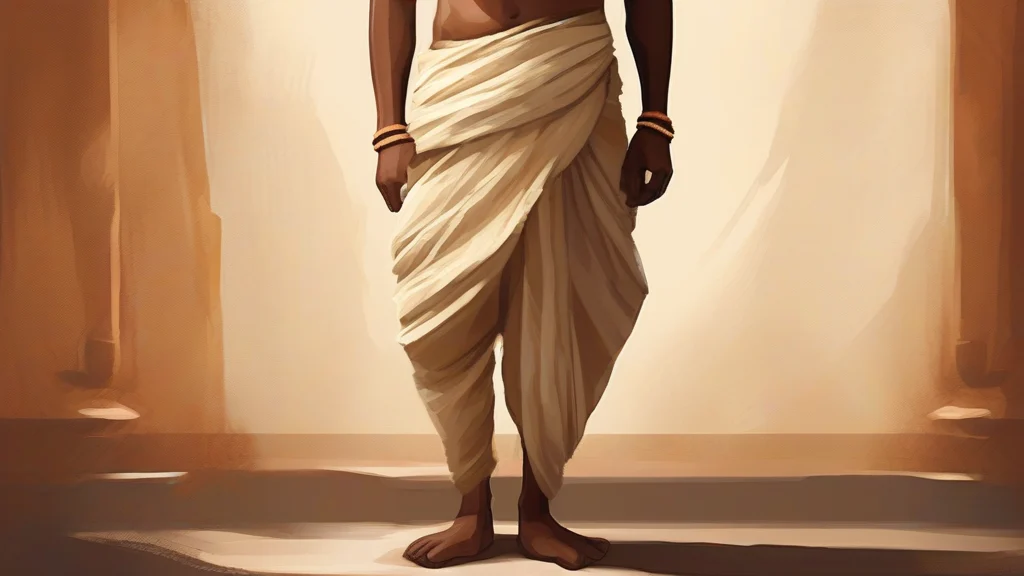
What does dhoti mean?
A dhoti is a traditional garment worn by men in India, consisting of a long rectangular length of unstitched cotton or silk cloth that is wrapped around the waist, drawn between the legs, and secured by knotting or tucking at the front. It ranges from plain white versions worn daily or for religious observance to richly colored silk varieties reserved for weddings and festivals. The dhoti is closely associated with Hindu tradition, rural life, and figures such as Mahatma Gandhi, who adopted it as a symbol of self-reliance during the independence movement. In contemporary India its everyday use has declined in favour of trousers and shirts, yet it retains ceremonial importance and remains common among priests, elders, and in classical dance. The word entered English from Hindi during the colonial era and is now firmly established in dictionaries of world English.
nounA loincloth worn by Hindu men in India, consisting of a long piece of unstitched cotton cloth wrapped around the waist and legs and knotted or tucked at the front.
- A loincloth of unstitched cloth wrapped around the waist and legs, traditionally worn by men in India.
"The elderly priest arrived at the temple wearing a simple white dhoti."
"He changed into a crisp cotton dhoti before performing the morning rituals."
"In many Indian states, politicians still campaign in homespun khadi dhotis to signal their connection to village life."
Also spelled 'dhuties' occasionally, but 'dhotis' is standard.
"The dancers adjusted their pleated dhotis before the performance began."
Gandhi wore one to meet the King of England — the dhoti is arguably the most politically powerful garment ever draped.
Reviewed by Deb Chak, Editor. AI-assisted content curated by RJS Tech Solutions LLP.
Etymology of dhoti
The word 'dhoti' comes from Hindi 'dhotī', which itself derives from Sanskrit 'dhvaja' meaning banner or flag, though some scholars connect it more directly to Sanskrit 'dhunoti' meaning 'to shake off' or 'to wash'. The term entered English during the British colonial period in India, appearing in English texts from the early nineteenth century as administrators and travellers documented Indian dress. It belongs to the family of South Asian garment terms borrowed into English alongside 'sari' and 'kurta'.
Related word forms
How dhoti is actually used
The word carries strong cultural and religious associations in South Asia; it denotes traditional dress rather than everyday Western-style clothing. The plural may be written 'dhotis' or 'dhuties', with 'dhotis' being far more common. In formal English writing it is often italicized as a foreign term, though this practice varies.
Easily confused with dhoti
A dhoti is a draped, unstitched cloth knotted at the waist worn especially for formal or religious occasions, while a lungi is typically a stitched tube of fabric worn casually around the home.