What does diaphragm mean?
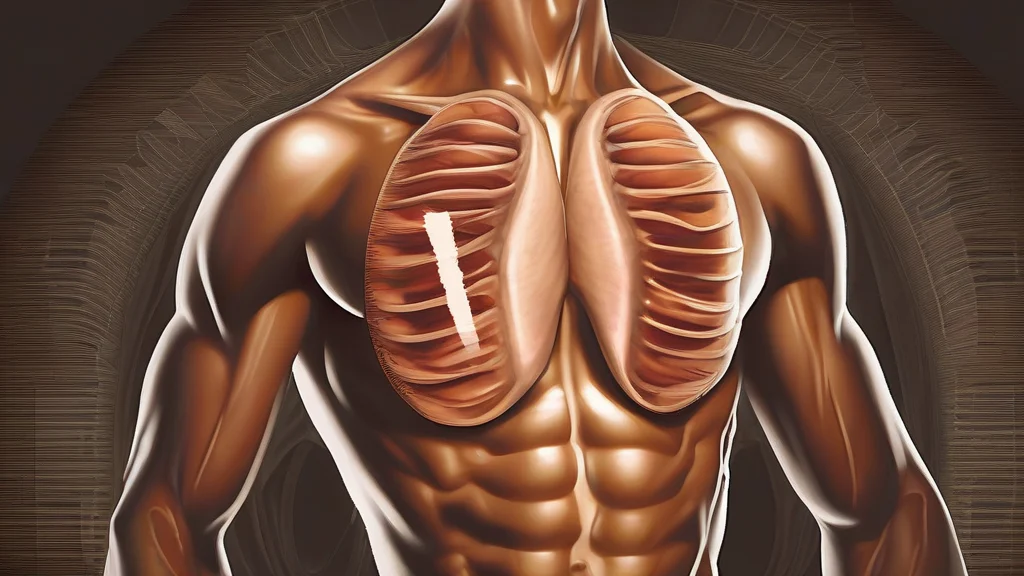
The diaphragm is a large, dome-shaped sheet of skeletal muscle that forms the floor of the chest cavity and separates it from the abdomen. As the principal muscle of breathing, it flattens when it contracts, drawing air into the lungs, and relaxes into its domed shape to push air out — a cycle repeated thousands of times each day, usually without conscious effort. Beyond anatomy, the word has broader technical senses: any thin dividing membrane may be called a diaphragm, as may the vibrating plate inside a microphone or loudspeaker that converts sound waves into electrical signals (or the reverse), and the adjustable iris-like mechanism in cameras that controls how much light reaches the film or sensor. It also names a domed rubber contraceptive cap worn over the cervix. The term derives from Greek roots meaning 'to partition through,' reflecting its role as the body's great internal divider.
A dome-shaped sheet of muscle separating the chest cavity from the abdominal cavity and serving as the primary muscle of breathing.
"The doctor explained that hiccups are involuntary spasms of the diaphragm."
This anatomical sense is the most common and familiar use of the word.
A thin dividing membrane or partition separating two cavities or compartments, whether in the body or in machinery.
"Pressure changes on either side of the diaphragm caused the gauge needle to move."
A thin vibrating plate in devices such as microphones and loudspeakers that converts between sound waves and electrical signals, or an adjustable aperture mechanism in a camera lens.
"The studio microphone's delicate diaphragm captured every nuance of the performance."
A shallow, domed rubber or silicone cap fitted over the cervix as a barrier method of contraception.
"She discussed using a diaphragm with her gynecologist at her annual appointment."
Regular plural formation. Used both for multiple anatomical structures (e.g., across patients) and, commonly, for multiple contraceptive devices.
"The clinic stocked several sizes of diaphragms to fit different patients."
Every breath you take depends on one dome-shaped muscle that contracts about 20,000 times a day without your ever thinking about it.
Reviewed by Deb Chak, Editor. AI-assisted content curated by RJS Tech Solutions LLP.
Etymology of diaphragm
The word 'diaphragm' entered English in the early 17th century, borrowed from Late Latin 'diaphragma,' which itself came from Greek 'diaphragma,' meaning 'a partition or barrier.' The Greek noun derives from the verb 'diaphrassein,' formed from 'dia-' ('through, across') and 'phrassein' ('to fence in or enclose'), so the word literally means something that divides by running across. The same Greek root 'phrassein' gives English words like 'diaphanous,' which describes material so thin it lets light through. Its anatomical sense was established first, with the optical and mechanical senses developing later alongside those technologies.
How diaphragm is actually used
Formal-to-neutral register; common in medical, anatomical, photographic, and musical contexts. In singing and voice pedagogy, phrases like 'support from the diaphragm' are standard, though anatomists note the muscle cannot literally be controlled in the way singers sometimes describe.
Easily confused with diaphragm
Not a confusable word per se, but 'diaphragmatic' is simply the adjectival form referring to the muscle itself rather than a separate condition.