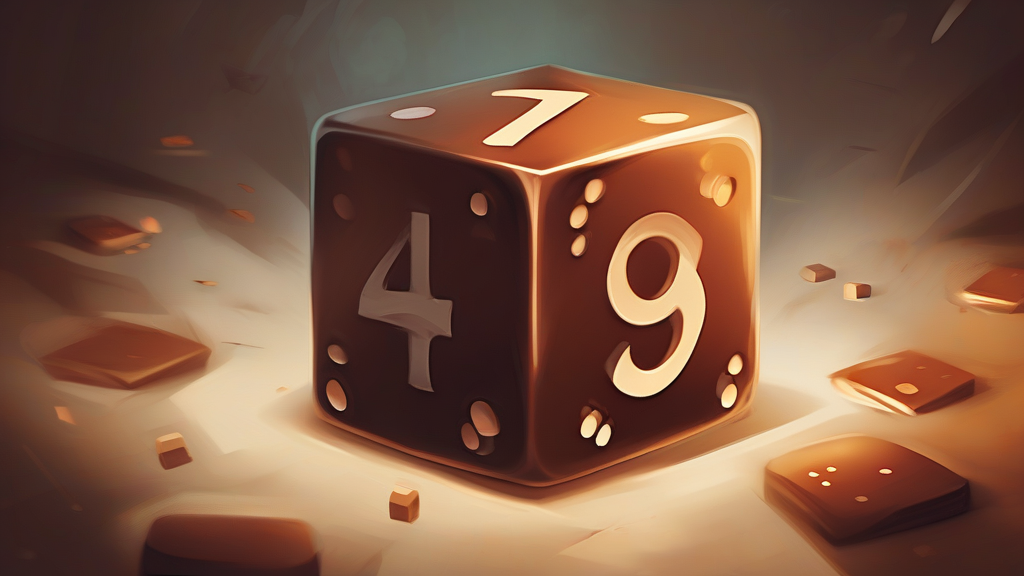
What does dice mean?
Dice are small cubes, traditionally made of ivory, bone, wood, or plastic, whose faces bear from one to six dots called pips. Thrown or rolled onto a flat surface, they generate random numbers that determine moves in countless games, from backgammon and craps to Monopoly and Yahtzee. The word also functions as a verb meaning to cut food into small uniform cubes, as when a recipe instructs you to dice an onion. Traditionally "die" served as the singular of "dice," but in modern usage "dice" commonly does duty for both singular and plural, so people say "the dice is loaded" as readily as "the dice are scattered." The word carries associations of chance, risk, and luck — to "roll the dice" figuratively means to take a gamble — while the phrase "no dice" signals rejection or bad luck. Few objects so tiny have shaped human leisure, probability theory, and language itself as thoroughly as dice have.
A small cube with each face bearing one to six dots, rolled in games to produce a random number between one and six.
"He handed her the dice and told her to roll."
Traditionally singular "die," plural "dice"; "dice" is now often used as the singular as well.
To cut food into small cubes of roughly even size.
"Dice the potatoes and boil them until tender."
The traditional singular is "die," but "dice" is widely used today as both singular and plural in informal English.
"She picked up the dice and gave them a shake."
The dots on a die are called pips, and opposite faces always add up to seven — a design that hasn't changed since ancient times.
Reviewed by Deb Chak, Editor. AI-assisted content curated by RJS Tech Solutions LLP.
Etymology of dice
The word "dice" comes through Middle English from the Old French "dé" (plural "dés"), which itself derives from the Latin "datum," meaning "something given" — a fitting origin for objects that deliver whatever number chance provides. "Datum" is the past participle of "dare," "to give." This makes "dice" a cousin of words like "date," "data," "donate," and "dative," all tracing back to that same Latin verb of giving. Historically, the singular was "die" and "dice" its plural; over recent centuries, however, "dice" has increasingly taken on the role of both singular and plural in common speech.
Related word forms
How dice is actually used
Strictly speaking, "die" is singular and "dice" is plural, but using "dice" as the singular ("roll the dice") is now widespread and fully accepted in everyday English, especially in informal contexts. In cooking, "dice" implies smaller, more uniform pieces than "chop" or "cube." The phrase "no dice" is informal American English meaning refusal or failure.
Easily confused with dice
"Die" is the traditional singular form referring to one cube, while "dice" is the plural — though modern usage increasingly treats "dice" as both singular and plural.