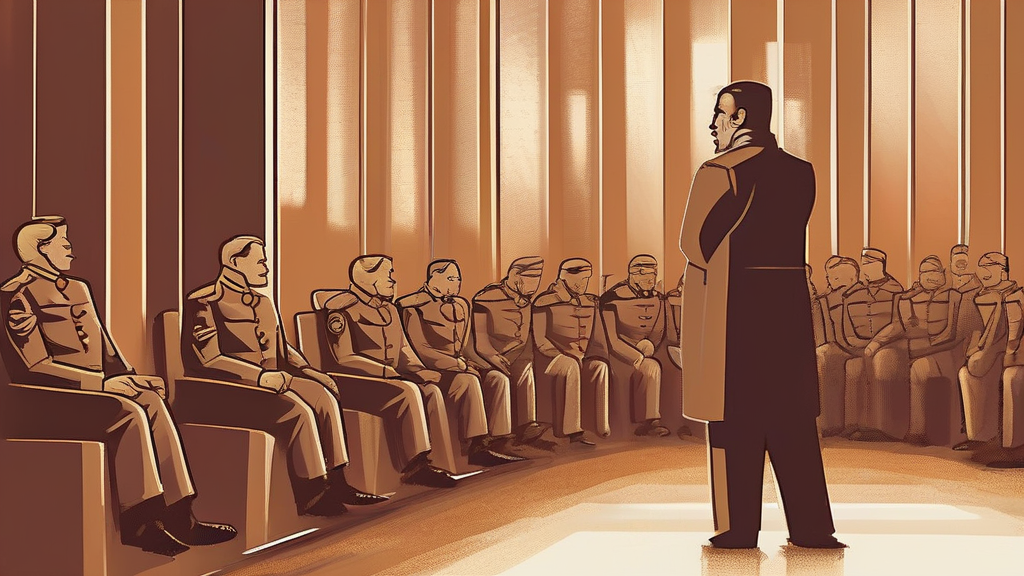
What does dictator mean?
A dictator is a ruler who wields absolute power over a country, usually having seized control by force and governing without meaningful legal or constitutional restraint. The modern sense of the word is overwhelmingly negative: it evokes censorship, political repression, personality cults, and the suppression of dissent, and it stands in contrast to concepts like democracy, accountability, and the rule of law. The term can also be applied figuratively to anyone who dominates others in an arbitrary, tyrannical way — a household tyrant, a micromanaging boss, or, half-jokingly, a project lead whose decisions are final. Historically, however, the word began more neutrally: in the Roman Republic a 'dictator' was a legally appointed magistrate given emergency powers for a limited term. That original meaning has been almost entirely eclipsed, and today calling someone a dictator is nearly always a serious political accusation. Related forms include dictatorship, the system or period of rule itself, and dictatorial, describing domineering behavior.
nounA ruler with total power over a country, typically one who has obtained control by force or maintains it by repression, without constitutional limits. More broadly, a person who behaves in an imperiously domineering or tyrannical way.
- A ruler who holds absolute power over a state, especially one acquired or maintained by force and unrestrained by law or constitution.
- A person who dictates or orders others about in an overbearing, tyrannical manner (e.g., in domestic or workplace contexts).
"The dictator ruled the country for three decades, silencing all opposition through fear and censorship."
"After seizing power in a coup, the general became one of the most feared dictators of the twentieth century."
"Her father was such a dictator at home that no one dared disagree with him about anything."
Standard English plural; countable noun.
"History is full of dictators who rose to power during times of crisis."
In ancient Rome, 'dictator' was a legal office — a magistrate appointed for six months to save the Republic in a crisis — and it only became a term of abuse centuries later.
Reviewed by Deb Chak, Editor. AI-assisted content curated by RJS Tech Solutions LLP.
Etymology of dictator
Dictator comes from the Latin 'dictator', the title of an extraordinary magistrate in the Roman Republic appointed during crises to hold supreme authority for a limited period, originally derived from 'dictare', meaning to dictate or prescribe. The word entered English in the late sixteenth century, initially retaining its Roman historical sense before acquiring its modern meaning of an absolute, oppressive ruler in the nineteenth century, particularly after figures like Napoleon. It shares its Latin root with words such as dictate, prediction, verdict, and diction, all tracing back to 'dicere', meaning to say or declare.
Related word forms
How dictator is actually used
The word carries strongly negative connotations in modern political usage, implying repression and illegitimacy; leaders rarely describe themselves as dictators, preferring terms like 'president'. The phrase 'benevolent dictator' is used, sometimes ironically, for an absolute ruler regarded as acting in the public good — and figuratively in computing and other fields for an unquestioned decision-maker.
Easily confused with dictator
Dictation is the act of speaking words aloud for someone to write down or transcribe, whereas a dictator is a ruler or person exercising absolute power.