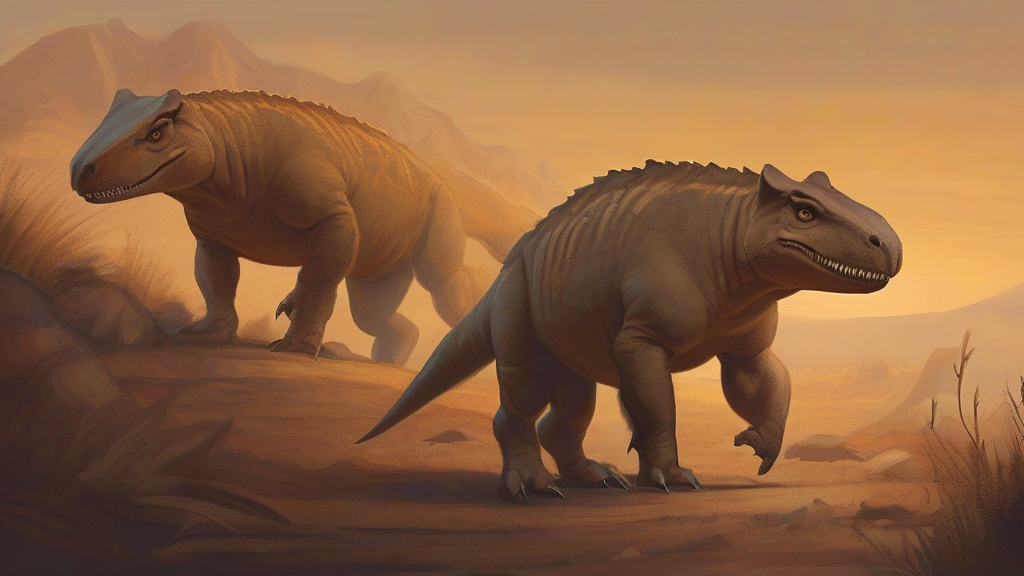
What does dicynodont mean?
A dicynodont is an extinct plant-eating relative of mammals belonging to the group Dicynodontia, which flourished during the Permian and Triassic periods. The name literally means 'two dog teeth,' referring to the pair of prominent tusk-like upper teeth found in many species, while others lacked tusks entirely and instead had sharp cutting plates. Instead of a full set of chewing teeth, dicynodonts possessed a horny, turtle-like beak used to crop vegetation. They were extraordinarily successful — at times among the most abundant large land animals on Earth — and notably some, such as Lystrosaurus, survived the catastrophic end-Permian mass extinction about 252 million years ago. The group eventually declined through the Triassic as dinosaurs rose. The word appears almost exclusively in scientific and natural-history contexts, where it denotes both individual species and members of the broader lineage.
nounAn extinct herbivorous synapsid reptile of the Permian and Triassic periods, characterized by a beak-like jaw and only two enlarged tusk-like teeth in the upper jaw (or none at all). Dicynodonts were among the most successful and widespread land vertebrates before the rise of the dinosaurs.
- Any extinct herbivorous synapsid reptile of the infraorder Dicynodontia, of the Permian and Triassic periods, having two tusk-like upper teeth and a turtle-like beak.
"The museum's new wing features a remarkably complete dicynodont skeleton unearthed in Zambia."
"Lystrosaurus, a dicynodont, became one of the few large land animals to survive the end-Permian extinction."
"Paleontologists identified the dicynodont by its distinctive pair of downward-curving tusks."
Standard English plural; used when referring to multiple individuals or species of the group.
"Dicynodonts dominated terrestrial herbivore niches for millions of years before the dinosaurs took over."
Dicynodonts survived the largest mass extinction in Earth's history — the Permian die-off that killed roughly 90% of species — making them one of evolution's great comeback stories.
Reviewed by Deb Chak, Editor. AI-assisted content curated by RJS Tech Solutions LLP.
Etymology of dicynodont
The term 'dicynodont' derives from Greek elements: 'di-' meaning 'two', 'kyōn' meaning 'dog', and 'odōn' meaning 'tooth' — together 'two dog-teeth', a reference to the pair of tusk-like canines characteristic of these animals. The name was coined in the 19th century following the description of early fossil finds from South Africa and elsewhere. It shares its roots with other '-odont' paleontological terms such as 'cynodont' ('dog-tooth') and with common dental vocabulary like 'canine' and 'periodontal'.
Related word forms
How dicynodont is actually used
A technical term used mainly in paleontology and natural-history writing; rare in everyday speech.
Easily confused with dicynodont
Cynodonts were a related but distinct group of synapsids that gave rise to mammals, whereas dicynodonts were tusked, beaked herbivores on a different branch.