What does dika mean?
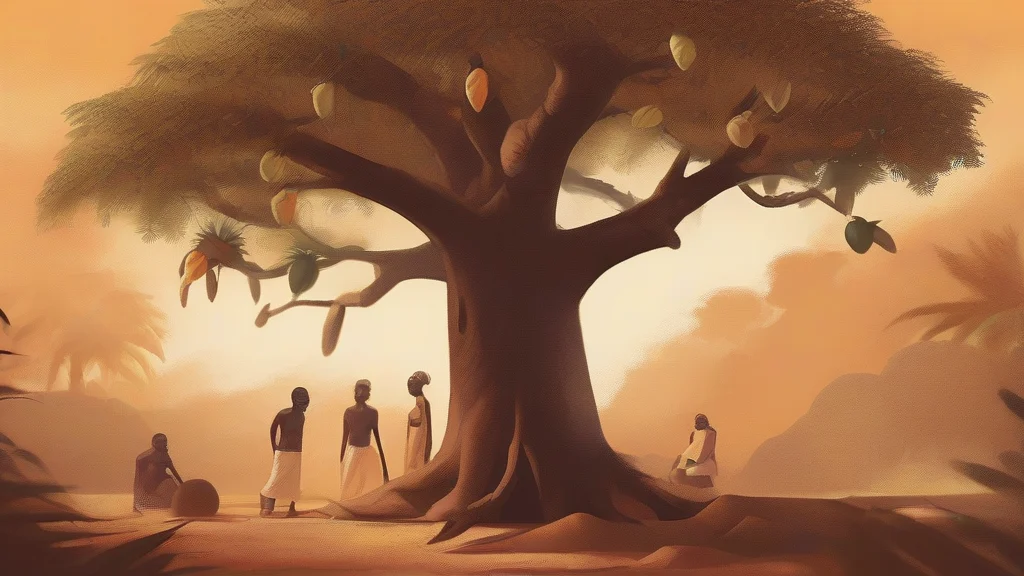
Dika is the name of a tall evergreen tree native to West and Central Africa, botanically known as Irvingia gabonensis and commonly called the wild mango or bush mango. The tree produces sweet, fibrous fruits that are eaten fresh, but it is prized above all for its seeds — hard, oil-rich kernels known as dika nuts. These kernels can be eaten like nuts, pressed to yield cooking oil, or dried and ground into a paste that thickens the beloved West African dish ogbono soup. Dika also refers to the seeds themselves, making the word serve for both the plant and its product. Because the kernels are high in fat and protein, dika has drawn attention in nutrition research and agroforestry, where the tree is promoted both for food security and for income generation. The word carries warm associations with West African home cooking, though in English it remains largely confined to culinary, botanical, and agricultural writing rather than everyday speech.
A large West African tree, Irvingia gabonensis, whose sweet fruit and oil-rich kernels are widely used as food; the wild mango or bush mango.
"Dika trees grow wild across the rainforests of Nigeria, Cameroon, and Gabon."
Often qualified as 'dika tree' or 'dika nut' when the specific sense needs clarifying.
The edible, oil-rich seed or kernel of the dika tree, used whole, pressed for oil, or ground into a paste for thickening soups.
"Ground dika gives ogbono soup its characteristic slippery thickness."
In much of West Africa this sense is more often called 'ogbono'; 'dika' predominates in botanical and nutritional texts.
Regular plural; used when referring to multiple trees or multiple kernels, though the mass noun sense (the ground meal) is uncountable.
"The plantation now holds several hundred mature dikas."
The dika nut is so rich in fat that it can be eaten like a nut, pressed for oil, or ground into 'dika bread' — one tree, three pantry staples.
Reviewed by Deb Chak, Editor. AI-assisted content curated by RJS Tech Solutions LLP.
Etymology of dika
Dika entered English from a language of West Africa — sources trace it to Igbo or a related Niger–Congo language of southern Nigeria — during the period of European botanical and ethnographic study of the region, likely in the nineteenth century. It names Irvingia gabonensis, classified in the nineteenth century by French botanists working along the Gabon coast. The word has no Latin, Greek, or Germanic cognates in English; it belongs to the small set of borrowings that arrived with African plants and foods. Related local names include ogbono (Yoruba) and odika/odika butter, a variant form sometimes met in trade literature on African fats.
How dika is actually used
Dika is a relatively specialised word, most often encountered in discussions of West African cuisine, agriculture, nutrition, and forestry. In Nigerian contexts the Yoruba-derived name 'ogbono' is more common for the seed, while 'dika' (of Igbo/Efik origin) appears frequently in botanical and nutritional literature. The spelling is stable and the word takes a regular plural.
Easily confused with dika
A dike is an embankment built to prevent flooding (or, in geology, a sheet of igneous rock), whereas dika is a West African fruit-and-nut tree used for food.