
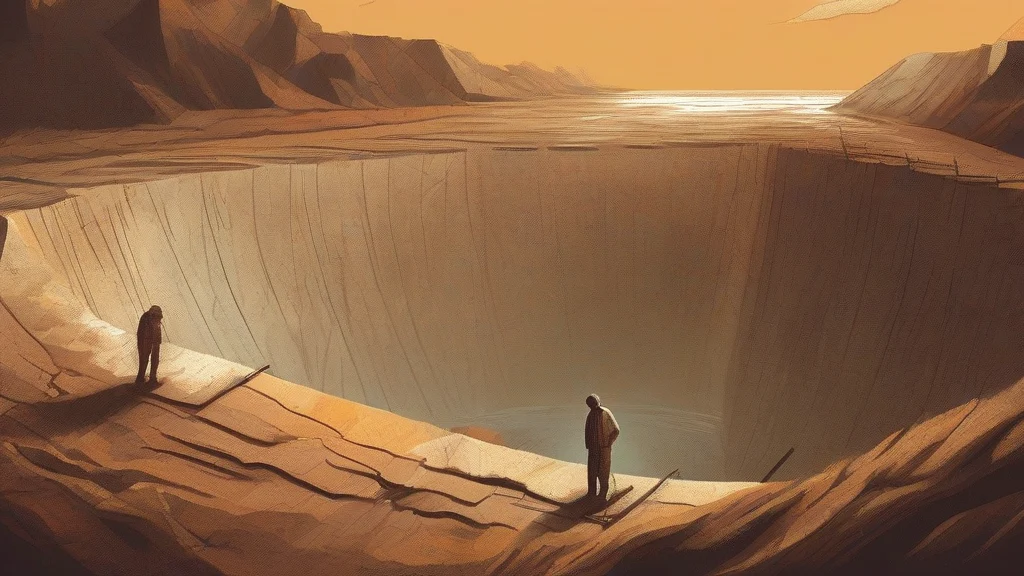
What does diking mean?
Diking refers to the construction and upkeep of dikes — embankments of earth, stone, or concrete raised along rivers, coasts, and other bodies of water to keep them from flooding adjacent land. The practice is central to water management in low-lying countries such as the Netherlands, where generations of diking have reclaimed farmland from the sea and protected communities below sea level. Beyond civil engineering, diking has a specialized geological sense: it describes the process by which molten rock forces its way into cracks in existing strata, hardening into wall-like sheets called dikes. The word carries connotations of human ingenuity and persistence against natural forces, and it appears most often in technical, historical, and environmental writing rather than everyday conversation.
nounThe construction or maintenance of dikes (embankments built to prevent flooding); also, in geology and mining, a sheet of igneous rock or a mineral vein that cuts across the grain or bedding of surrounding rock.
- The act or practice of constructing dikes or embankments to protect land from flooding, especially in low-lying regions.
- In geology: the intrusion of magma into a vertical fracture to form a dike, or the presence of such formations.
"Centuries of careful diking have kept the Netherlands' lowlands dry."
"The villagers began diking the riverbank before the spring thaw arrived."
"The region's distinctive landscape was shaped by ancient volcanic diking."
Without centuries of diking, nearly half of the Netherlands would be underwater today.
Reviewed by Deb Chak, Editor. AI-assisted content curated by RJS Tech Solutions LLP.
Etymology of diking
Diking derives from the noun 'dike', which entered Middle English around the thirteenth century from Middle Dutch 'dijc' or Middle Low German 'dīk', meaning an embankment or causeway — itself related to Old English 'dīc', meaning a ditch or channel dug as an earthwork. The same Germanic root gives us the modern word 'ditch'. The gerund form 'diking' arose naturally to describe the ongoing activity of building such embankments, particularly in the context of land drainage and flood defense.
How diking is actually used
Most common in engineering, hydrology, and land-reclamation contexts. In American English 'levee' is often preferred for river flood protection, while 'diking' remains standard for sea defenses and land reclamation. The spelling variant 'dyking' is more common in British English.
Easily confused with diking
Hiking is walking long distances outdoors for pleasure; diking is building embankments to hold back water — they rhyme but are unrelated.