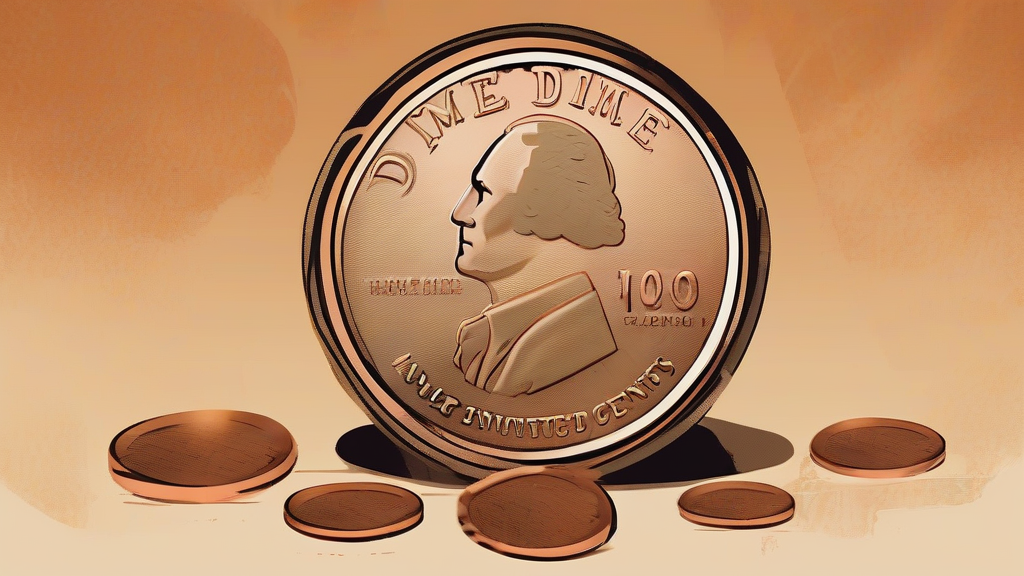
What does dime mean?
A dime is a United States coin worth ten cents — one tenth of a dollar. First minted in the 1790s, it is the smallest US coin in common circulation today, struck in a copper-nickel alloy and bearing the portrait of President Franklin D. Roosevelt on its obverse since 1946. Beyond its literal monetary value, dime has taken on a rich figurative life in American English: something described as "a dime a dozen" is abundant and therefore of little worth, while a vehicle that can "turn on a dime" changes direction with remarkable precision — an image drawn from the coin's small size. The word also survives in historical phrases like "dime novel" and "dime store," recalling an era when ten cents bought popular entertainment or everyday goods. Though unfamiliar outside North America, the dime remains deeply embedded in American idiom and everyday commerce.
nounA dime is a US coin worth ten cents, the smallest denomination of US coinage in everyday use. Informally, a dime can also mean a small amount of money.
- A US coin worth ten cents.
- Informally, a small amount of money or a trivial sum.
"She fished a dime out of her pocket to feed the parking meter."
"The vending machine wouldn't take my crumpled dime."
"In this town, good advice isn't exactly a dime a dozen."
Regular plural formation; commonly used when referring to amounts of money in dimes.
"The jar was full of loose dimes and quarters."
"Stop on a dime" — the phrase works because a dime is so small that turning on one implies impossible precision.
Reviewed by Deb Chak, Editor. AI-assisted content curated by RJS Tech Solutions LLP.
Etymology of dime
Dime comes from the Old French "disme" (modern French "dixième"), meaning "a tenth," which derives from Latin "decimus," also meaning "tenth." The word reflects the coin's original definition as one tenth of a dollar under the decimal system established by the Coinage Act of 1792. English also borrowed "disme" earlier in a now-obsolete sense of "tithe." The same Latin root gives us decimal, decade, decimate, and December.
Related word forms
How dime is actually used
Dime is informal-to-neutral in register and almost exclusively American; British speakers would not use it except when discussing US currency. It appears frequently in idioms such as 'a dime a dozen' (very common and therefore cheap) and 'turn on a dime' (change direction very sharply).
Easily confused with dime
A nickel is worth five cents, half the value of a dime.
A quarter is worth twenty-five cents, two and a half times the value of a dime.