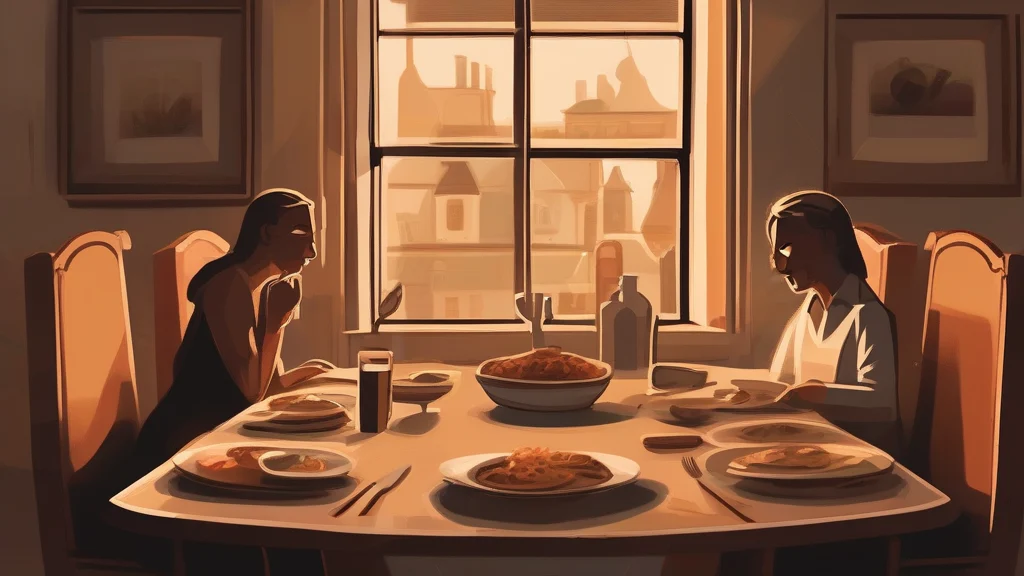
What does dinnering mean?
Dinnering is the present participle and gerund of the now-uncommon verb 'to dinner,' meaning to eat one's main meal of the day. Where the noun 'dinner' names the meal itself, the verbal form describes the act: guests might be found dinnering at an inn, a hotel, or a friend's table. The word belongs to the same family as 'dine' and 'dining,' all tracing back through Old French 'disner' to Vulgar Latin roots meaning essentially to break one's fast. Today 'dinnering' is rare and carries a distinctly old-fashioned or literary flavour; contemporary writers overwhelmingly choose 'dining' instead. It survives chiefly in historical prose, period fiction, and occasional humorous or deliberately archaic writing. Encountering it, a reader should understand it simply as the act of taking dinner, typically with some suggestion of formality or leisure rather than a quick bite.
verb (present participle / gerund)The present participle or gerund of the verb 'dinner,' meaning to eat dinner, especially a formal or main midday or evening meal.
- Eating dinner, especially in a formal or leisurely way (present participle of the verb 'to dinner').
"They spent the evening dinnering at a riverside hotel."
"The travellers were dinnering when the storm broke over the inn."
"He wrote that he had spent his holiday dinnering with friends in Provence."
Before 'dining' took over the menus of the world, English speakers happily went 'dinnering' — a verb hiding inside the noun we use every day.
Reviewed by Deb Chak, Editor. AI-assisted content curated by RJS Tech Solutions LLP.
Etymology of dinnering
Dinnering derives from the verb 'to dinner,' formed from the noun 'dinner,' which came into Middle English from Old French 'disner.' The Old French word originally meant 'to break one's fast,' from presumed Vulgar Latin '*disjejunare,' combining a negative prefix with Latin 'jejunare,' to fast. The verbal form 'dinnering' appears in earlier centuries of English but has largely given way to 'dining' from the parallel French-derived verb 'dine.' Its closest living relatives are 'dine,' 'diner,' and 'dinner' itself.
How dinnering is actually used
Rare and somewhat archaic or literary today; modern usage strongly prefers 'dining.' The verb 'to dinner' itself survives mainly in older texts and formal or playful registers.
Easily confused with dinnering
'Dining' is the standard participle of 'dine' and is far more common; 'dinnering' is an older, rarer form built directly on the noun-turned-verb 'dinner.'