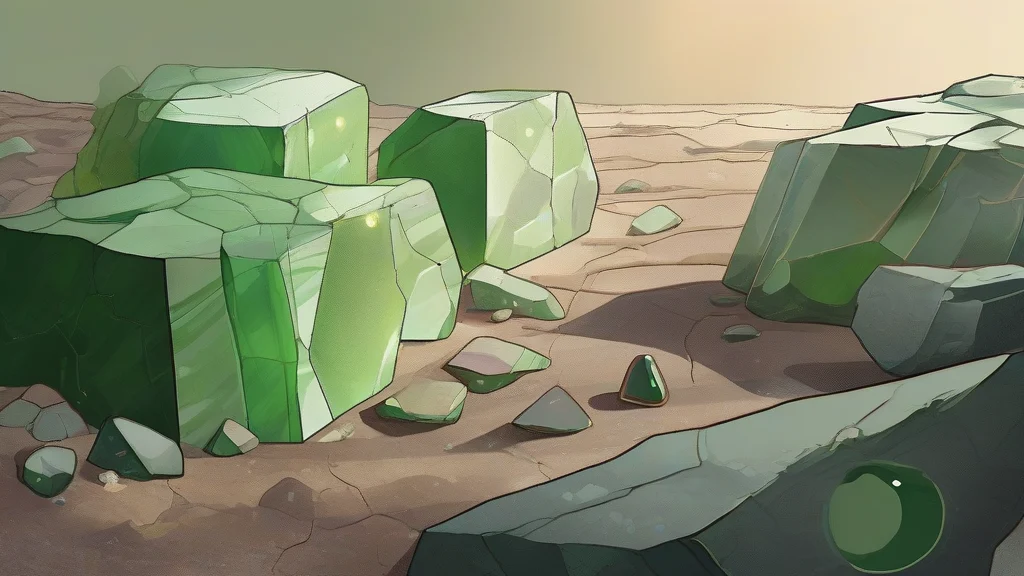
What does diopside mean?
Diopside is a rock-forming silicate mineral belonging to the pyroxene group, composed chemically of calcium magnesium silicate (CaMgSi₂O₆). It typically appears white, pale grey, or various shades of green, and occurs widely in igneous rocks such as gabbros and diabases as well as in metamorphic rocks like skarns and marbles. Its name derives from Greek words meaning 'double appearance', a reference to its pronounced double refraction of light. While most diopside is ordinary rock-forming material, some varieties are valued by collectors and jewellers: chrome diopside, coloured deep green by chromium, is cut as an affordable gemstone, and star diopside displays four-rayed asterism when cut en cabochon. Because of its importance in petrology, the word appears mainly in geology texts, mineralogical descriptions, and gem-trade literature rather than everyday speech, making it a specialist term worth knowing for readers interested in earth science or gems.
nounA grey-green to dark green monoclinic pyroxene mineral consisting of a calcium magnesium silicate, occurring in many igneous and metamorphic rocks and sometimes cut as a gemstone.
- The mineral CaMgSi₂O₆, a monoclinic pyroxene common in igneous and metamorphic rocks.
- A gemstone variety of this mineral, especially the chromium-rich green form known as chrome diopside.
"The pendant was set with a vivid chrome diopside mined in Siberia."
"Thin veins of white diopside ran through the marble quarried near the village."
"Chrome diopside offers an affordable alternative to emerald for green gemstone jewellery."
The plural is used when referring to specimens or distinct varieties of the mineral; as a mass noun referring to the substance, diopside normally remains uninflected.
"The museum case displayed diopsides from several localities, including Siberia and Madagascar."
Its name means 'double appearance' in Greek — because the mineral splits light into two rays, you literally see everything through a diopside crystal twice.
Reviewed by Deb Chak, Editor. AI-assisted content curated by RJS Tech Solutions LLP.
Etymology of diopside
Diopside was named in the early nineteenth century from the French diopside, built on Greek elements: di-, meaning 'twice' or 'double' (from dis), and opsis, meaning 'appearance' or 'sight'. The name refers to the mineral's strong double refraction, which gives images seen through a clear crystal a doubled look. It shares the Greek sight-root with words such as synopsis, autopsy, and optic, and the 'two' element with words like dioxide.
Related word forms
How diopside is actually used
Diopside belongs chiefly to geological, mineralogical, and lapidary registers; it appears rarely outside scientific writing, gem trade catalogues, and collector contexts. In the gem trade it is usually named by its colour prefix, as in chrome diopside or star diopside.
Easily confused with diopside
Dioptase is an emerald-green copper silicate mineral, whereas diopside is a calcium magnesium pyroxene that ranges from white to dark green.
A diapsid is a reptile whose skull has two pairs of temporal openings, while diopside is a silicate mineral — the words merely sound alike.