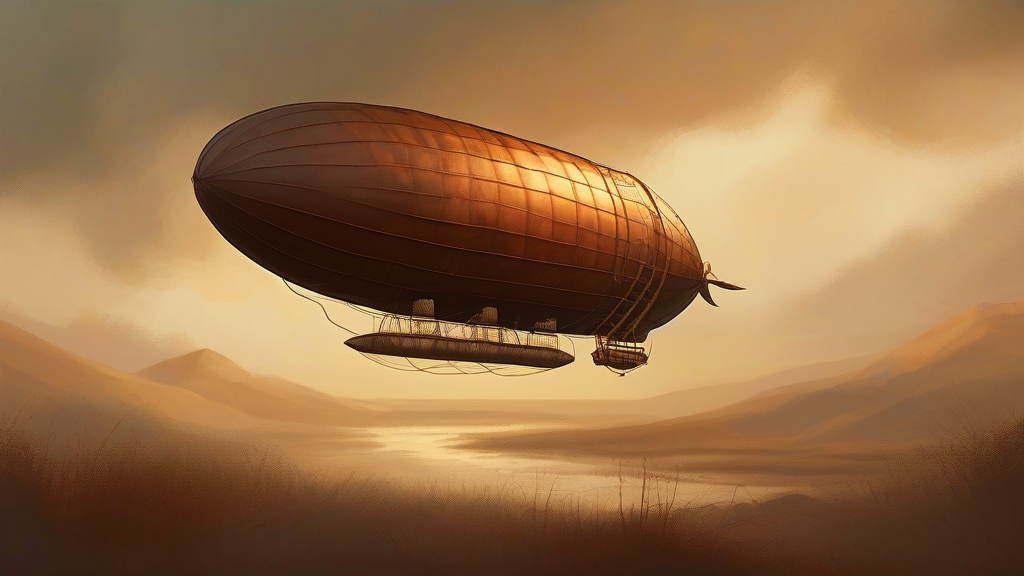
What does dirigible mean?
A dirigible is a large, engine-powered aircraft that floats through the air because its envelope contains a gas lighter than air, such as helium or hydrogen. Unlike a free balloon, which drifts wherever the wind carries it, a dirigible can be steered under power using engines, rudders, and elevators — hence the name, derived from the Latin dirigere, meaning "to direct." Dirigibles are classified as rigid, semi-rigid, or non-rigid depending on whether they have an internal framework; the famous Zeppelins were rigid dirigibles, while the smaller pressure-maintained blimps are non-rigid ones. Dirigibles reached their peak of popularity in the early twentieth century as passenger transports and naval scouts, but a series of high-profile disasters, most notably the Hindenburg fire of 1937, largely ended their commercial use. Today they survive mainly as advertising platforms, surveillance platforms, and objects of nostalgic fascination.
nounA large, steerable lighter-than-air aircraft, typically with a rigid or semi-rigid frame, that is propelled by engines and controlled by rudders and elevators.
- A large, engine-powered, steerable lighter-than-air aircraft (an airship).
"A massive dirigible drifted silently above the harbor, its silhouette dark against the morning sky."
"The navy's rigid dirigible completed a transatlantic crossing in 1919."
"Tourists marveled at the sight of a modern advertising dirigible gliding over the stadium."
Standard plural form used when referring to multiple airships.
"Several dirigibles were moored along the airfield during the exhibition."
The Hindenburg was a dirigible — and after it burst into flames in 1937, it effectively ended an entire era of air travel overnight.
Reviewed by Deb Chak, Editor. AI-assisted content curated by RJS Tech Solutions LLP.
Etymology of dirigible
The word "dirigible" comes from the Latin dirigere, meaning "to set straight" or "to direct," formed from di- (apart, across) plus regere (to rule, guide), the same root that gives English words such as "direct" and "regulate." It entered English via French dirigeable in the late nineteenth century, when engineers first succeeded in making balloons steerable rather than merely wind-driven. Although originally usable as an adjective meaning "steerable," it came to function almost exclusively as a noun for the aircraft itself.
How dirigible is actually used
"Dirigible" is somewhat formal or technical; "airship" is the more common general term today, while "blimp" is informal and refers specifically to non-rigid airships. The word is also occasionally used as an adjective meaning "steerable," though this is now rare.
Easily confused with dirigible
A blimp is a small non-rigid airship whose envelope holds its shape only through internal pressure, whereas a dirigible may be rigid or semi-rigid and is the broader term for any steerable airship.