What does disembarking mean?
To disembark is to leave a ship, aircraft, or other vehicle at the end of a journey. The word carries a slightly formal tone and appears most often in maritime, aviation, travel-industry, and military contexts — passengers disembarking a cruise liner, troops disembarking onto a beach, or cargo being unloaded from a vessel. It derives ultimately from Late Latin 'barca', meaning a small boat, which also gave English the word 'bark' (or 'barque') for a sailing ship. Its opposite, 'embark', means to board or begin a voyage, so the two form a natural pair: you embark at the start of a trip and disembark when you arrive. In everyday conversation, speakers more often say 'get off' for buses and trains, reserving 'disembark' for larger vessels and aircraft.
verb (present participle of disembark); also noun (gerund) in some contextsThe act of leaving a ship, aircraft, or other vehicle after a journey; getting off a vessel or craft.
- To leave a ship, aircraft, or other vehicle after a voyage.
- (Figurative, less common) To remove or unload goods or people from a vessel.
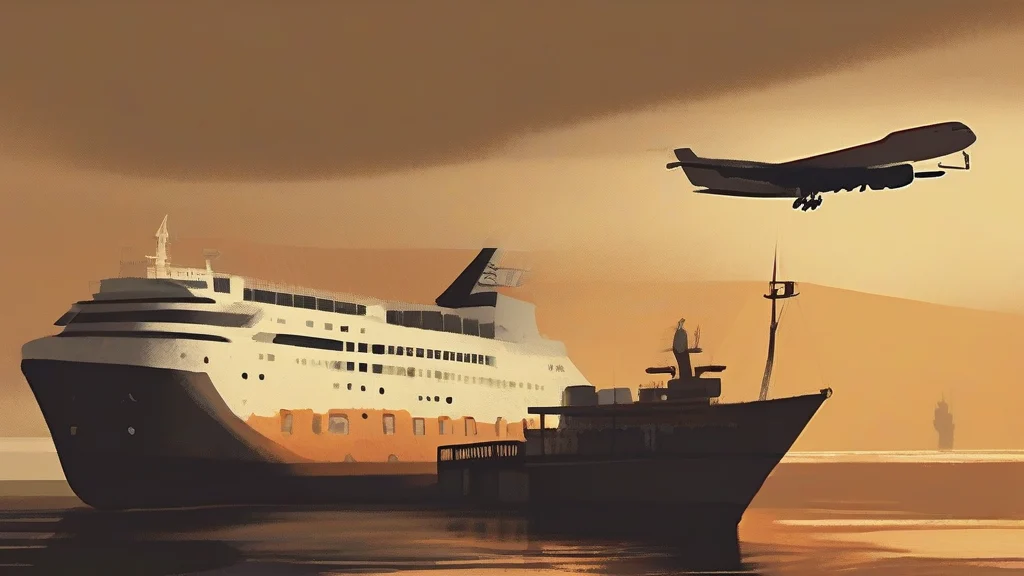
"Passengers began disembarking the cruise ship as it docked at the port."
"Passengers waited patiently before disembarking the ferry at Dover."
"The troops were disembarked at dawn under cover of darkness."
Every time you step off a plane, you're performing an act whose root word — 'barca' — once meant a small boat in Latin, and gave us 'bark' as a synonym for ship.
Reviewed by Deb Chak, Editor. AI-assisted content curated by RJS Tech Solutions LLP.
Etymology of disembarking
Disembarking comes from the verb 'disembark', formed in English from the prefix 'dis-' (indicating reversal or removal) plus 'embark'. 'Embark' itself entered English in the 16th century from French 'embarquer', from Late Latin 'barca' meaning a small boat — the same root that gives English 'bark' or 'barque' for a sailing vessel. Cognates appear across the Romance languages, including Spanish 'embarcar' and Italian 'imbarcare'.
Related word forms
How disembarking is actually used
Formal to neutral register, common in travel, military, and maritime contexts. In everyday speech, 'get off' is more common for buses and trains; 'disembark' tends toward ships and planes. The spelling with '-k-' (not '-c-') reflects its Romance origin.
Easily confused with disembarking
Embarking means boarding a vessel or vehicle to begin a journey, while disembarking means leaving it at the end of one.